
Mayors hold special roles and responsibilities beyond those of councilmembers in most cities and yet have the same voting powers as every other councilmember.1 For the smooth functioning of the council and the business of government, city managers must develop and maintain healthy working relations with mayors, while serving all the members of their councils fairly and equally.
Finding the Balance
The ICMA Code of Ethics states that city managers are to serve all members of the governing body equally and impartially. It’s not only the right thing to do, but it’s the smart thing. All members of council are elected to serve their constituents equally, and they all need and expect the same level of respect and information.
Mayors have one vote like other members of council, but they also have additional duties and responsibilities.2 The partnership between the mayor and city manager is a critical one. It can be the difference between council meetings going productively or off the rails. It can also affect the trust and confidence the community holds for the council and city staff.
How Are Mayors Different from Other Councilmembers?
The mayor’s role differs from other members of council. The mayor leads council meetings, typically serves as the chief spokesperson for the city in ceremonial functions, often is the designated person to speak to the press on behalf of the city, and frequently is the elected official who represents the city to other governmental agencies. Due to the mayor’s role in council and public meetings, there is a particular need for the manager and mayor to collaborate and communicate closely for the effective functioning of the city.
In a council-manager form of government, mayors can be elected at large or appointed by the city council through a rotation or pre-set system. Mayors may have different terms than councilmembers. Some mayors only vote to break council vote ties; others may not vote at all. This article does not address the strong mayor form (where there are executive powers assigned to the mayor), since the topic of discussion here is the city manager/mayor partnership.
A wide range of people with varied backgrounds are elected as mayors of their communities. For directly elected mayors, these individuals may well be among the most active politicians in the city, have deep roots in the community, and enjoy large networks of supporters. Some have served other governing bodies, such as school boards. Other directly elected mayors may be new to city government, with a need to learn both the role of a governing body member and their own. The same range of experience is true for mayors appointed from among their peers—they may be new to city government or may have been on the council for many years.
Some mayors particularly enjoy the public interaction aspects of the role, and others gravitate toward governance responsibilities. Mayors may or may not have any management or supervisory experience. That is not essential given that the city manager is the chief executive officer in a council-manager system.
Mayors can play an important role in creating consensus on a council. While the “equal vote” rule matters,3 finding the magic middle ground where all members of council can support a policy can be the difference between moving forward collectively as a body, and having some members continuing to chafe after a decision is made. The city manager can also help in this regard by offering alternatives to help the entire council get to a collective “yes” in a way that helps solve a community problem.
Why Is the Relationship between the City Manager and Mayor Important?
While seeking to equitably serve all the members of the city council, city managers typically must collaborate closely with the mayor on matters pertaining to the agenda, speaking engagements, proclamations, or other duties that are assigned to the mayor in the charter or ordinances.
Yet city managers must be mindful of tensions that can be created with other members of council if they perceive the manager to be providing more information to or favoring the mayor over other members.
What characterizes the “special” relationship with the mayor that the city manager should have for effective governance and smooth government operations?
Both the mayor and city manager must respect that the two roles are different but complementary. The mayor has clear responsibilities regarding council meetings and other duties but is not in the business of running the organization. That is the city manager’s role. The line between policy and administration must be honored, but it requires collaborative conversations to foster mutual understanding.
Tenet 6 of the Code of Ethics states that elected representatives are accountable to their community for their decisions, while ICMA members are accountable for implementing those decisions. City managers are to refrain from participating in local politics and must take great pains to remain nonpolitical/nonpartisan, and impartial.
A key ingredient to a constructive relationship between the mayor and city manager is a commitment to each other’s success. As a basic value, the city manager should support the mayor in his or her role. Ideally, it is mutual, in that the mayor strives to support the manager’s success. This occurs best when there is a collaborative, communicative relationship between the two. Given that knowledge is power, a robust sharing of knowledge from both sides to the other is essential to maintain this balance.
The mayor and city manager should engage in regular communication about community issues, people who may appear at the next council meeting, and any concerns brewing that impact operations. These issues also can and should be conveyed by other members of council to the city manager. The city manager needs to be aware of such issues to course-correct and/or handle matters that are operational in nature.
The city manager must understand that, in the view of the community, the mayor is the face and voice of the city and the focal point for people seeking city services or influencing city policy. In many communities, people reach out to the mayor if they have questions because they are unclear about the city manager’s role. In a highly functioning organization, there is a good system of handing off these inquiries that come to the mayor to direct them to staff for follow up. Many residents look to the mayor for leadership on all city issues.
What a Collegial Working Relationship Looks Like
Effective governance is characterized by mayors, as well as all members of council, offering city managers their perspectives on community needs, city services, and likely reactions to changes. This takes good communication and must be done without directing the manager’s actions. Mayors can be sounding boards on administrative decisions if they do not impose their views on the city managers who are responsible and accountable for such decisions. Other members of the council should also serve as sounding boards.
City managers should advise the entire council, and may begin with the mayor, on the likely big-picture impacts and unintended side effects of proposed policies. There may be times that it’s appropriate for the city manager to brainstorm policy and administrative decisions with the mayor without violating the equal communication rule between the manager and all members of council.
Council Relations
Having a solid, open relationship with the mayor can also be helpful when there is an issue within the council. For instance, if a member of council is trying to direct staff, interfering in operations, or using social media in a way that creates confusion, the mayor may be able to have a one-on-one conversation with that councilmember about the impacts of those behaviors and on the role of the council. If the behavior persists, the city manager and mayor can confer about options for addressing the problem.
Smart city managers share information and knowledge; offer praise for mayors, councils, and staff when things go right; and then step out in front as the one accountable when things go badly. If relations are mutually supportive, often mayors and councilmembers will defend city managers in tough times as long as they feel included, respected, and fully informed.
Visioning and Messaging
Having a cogent vision for the city developed by the city council that is then reflected in budgets and action plans helps to align the entire organization, starting from the top. A vision and strategic plan that all members of the council have been part of creating is baseline for having a unified direction. The mayor can be influential with the council in this process, encouraging all members of the council to be full participants in this work. The manager and staff assist by developing a strategic planning process, providing facts and information to assist the council in setting the vision for the community, and implementing the strategic plan once developed.
When it comes to speaking to the media, many cities have a protocol that it is the mayor who is the spokesperson. The city manager has the responsibility to ensure that factual information is provided to all members of the council to support their speaking engagements, and to the mayor in his or her media responses.
The mayor and councilmembers should also reach out to the city manager to seek necessary information to best represent the city’s vision and unified direction of
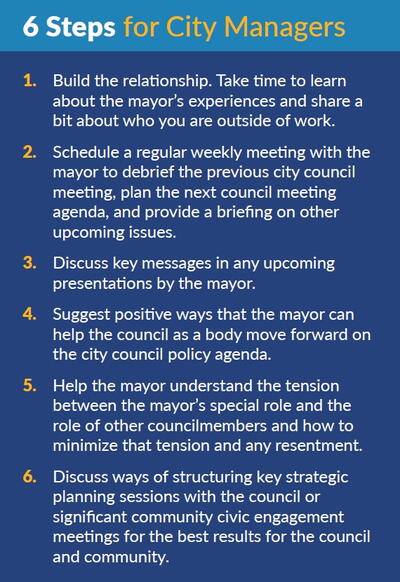
the council. The manager is also well advised to fully brief all members of the council on setbacks and roadblocks on projects and other issues so that no member is surprised and can be well-versed when speaking to groups or individuals. The mayor and city manager should collaborate before such talks and press conferences, so the mayor is truly prepared.
In times of emergency, this partnership is particularly important. The city manager has ultimate responsibility for leading the city response, and the mayor serves an important role in reassuring residents about the city’s response to the emergency.
The annual state of the city address presented by the mayor is the perfect example of how the two top officials can collaborate on messaging. Getting this annual message right is a way to instill confidence in city government. It also is a way of demonstrating a unified front by the entire city council and staff. It is an important undertaking for both the mayor and city manager.
Agenda Planning and Meeting Management
Agenda planning and council meeting debriefing are two areas where mayors and city managers should work together seamlessly as both have a large stake in how these public legislative meetings go. Agendas must be carefully developed to avoid peaks and valleys in terms of time spent on items during council meetings. The mayor and city manager will each have a sense of how much time topics will take for staff reporting, public comment, and council deliberation. Meetings that run too long or end too quickly are both ineffective and wasteful of the public’s time and attention.
Similarly, after each council meeting the mayor and city manager should review what went well and what could be improved. Close collaboration in agenda planning and meeting management benefits the public process and decision-making. These functions are particular to the mayor and city manager and rarely involve other councilmembers.
When Relations Are Strained
So, what happens when the mayor and city manager are not on the same wavelength, do not share similar values or visions for the city, or just plain don’t like one another?
Both need to put individual differences aside and do the right thing for the community and work collegially for the betterment of the municipality. This is more easily said than done but is bound up in the duties of these two leadership positions in city government. The nurturing of this critical relationship is just too important to neglect.
Mayors and city managers should set aside regular time to talk through the work together. These discussions do not have to be structured and can be over meals or coffee where everyday topics are also discussed. Trust, respect, and commitment to the community good are common bonds. If differences or discord between the two are such that the relationship is seriously compromised, the city manager may wish to ask the mayor to engage in neutral facilitated problem-solving for the well-being of the city.
Team Up with the Mayor for Results
It is often said that city government is the ultimate team sport. No one person can really accomplish much of anything alone. While the council, staff, community stakeholders, and volunteers all play their parts, the mayor and city manager must work closely and effectively for the system to operate at a high level.
As a professional administrator, the city manager should work closely with the mayor in a collegial, trusting, and collaborative fashion. As previously said, the city manager must also develop and sustain relationships with all members of the council. An effective mayor/city manager relationship benefits the community, council, and staff. Devoting time and goodwill as a city manager is in the best interests of all who rely on city government.
ROD GOULD, ICMA-CM, is chairman of the board of HdL Companies, a former ICMA Executive Board member, retired city manager, consultant, and supporter of all those who toil in local government service. (rodgould17@gmail.com)
JAN PERKINS, ICMA-CM, is vice president of Raftelis, a local government management consultant and facilitator, retired city manager, and a believer in good government and professional management. (jperkins@raftelis.com)
DR. FRANK BENEST, ICMA-CM, is a retired city manager and currently serves as a local government trainer and ICMA’s liaison for Next Generation Initiatives. (frank@frankbenest.com).
Endnotes
1 Note: Voting powers for mayors may vary by state.
2 In some cities, mayors only vote to break ties during council meetings or have no vote at all.
3 Again, some mayors may not vote on matters before the council except in the case of a tie or lack of quorum.
Publish with ICMA!
We’re searching for interesting and insightful stories that can help others learn a memorable takeaway to serve their communities better.
