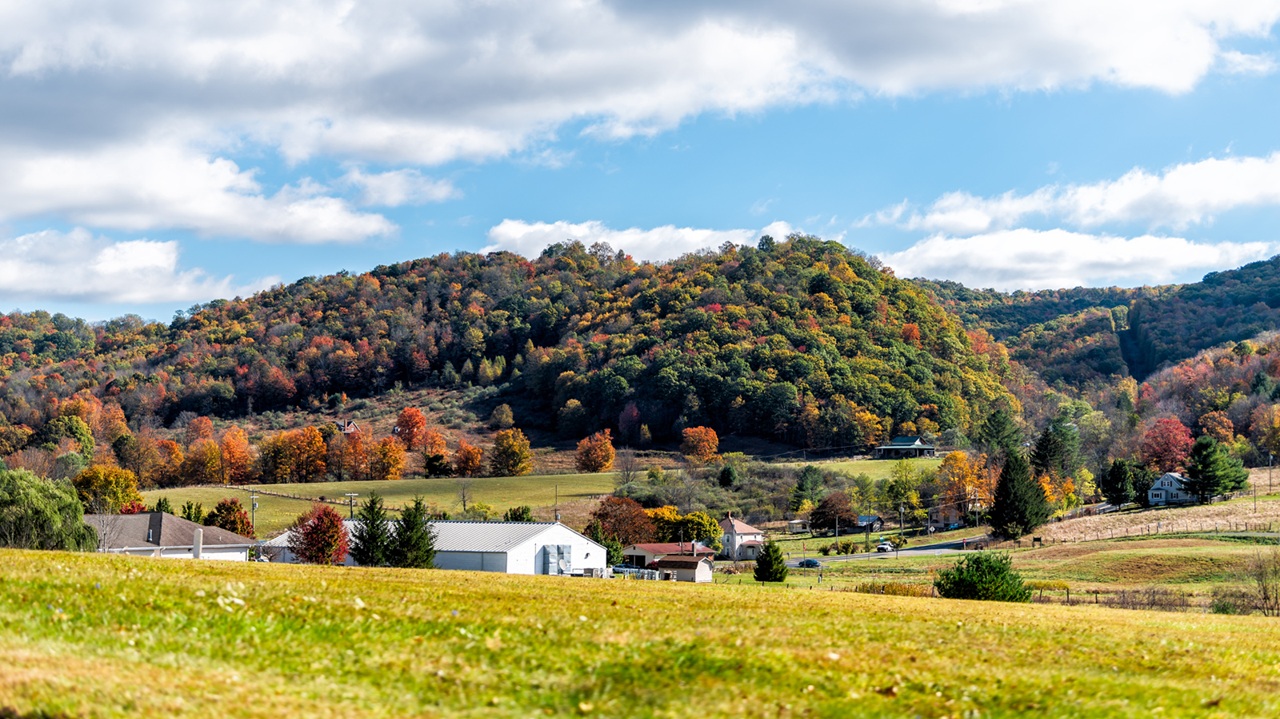
Landdis Hollifield has lived most of her life in Marion, North Carolina, a small town of 7,700 people nestled in the foothills of the Blue Ridge Mountains. She has seen firsthand the challenges that small, rural communities face and recalls the economic disruptions in the 1990s that were acutely felt on Main Street in Marion as businesses were boarded up and jobs left the region. She also knows that with strategic investments and community vision, it is possible to reimagine and rebuild.
Today, Landdis is an Economic Recovery Corps (ERC) fellow working in Highland County, Virginia. In 2024, Landdis packed up and drove the 320 miles from Marion to Highland County as she began the 30-month fellowship that was designed to connect experienced mid-career professionals like Landdis with organizations that needed additional capacity and resources to catalyze economic revitalization.
Led by the International Economic Development Council (IEDC) with funding from the U.S. Economic Development Administration, the ERC strengthens local economic development capacity by embedding fellows in host organizations working in distressed communities and regions. The program supported post-pandemic recovery while helping communities build resilience and pursue transformative, long-term change. Project partners—including ICMA, the National League of Cities, the National Association of Counties, the National Association of Development Organizations, and the Center for Rural Innovation—help support fellows and their host organizations.
The Corps is comprised of 65 fellows situated in host organizations in some of the most economically distressed communities and regions in the United States. Nicole Manapol, IEDC’s vice president of emerging practice, explains the theory behind the program:
“When we designed the Economic Recovery Corps, we recognized that many communities weren’t lacking ideas or ambition—they were lacking sustained capacity to coordinate, implement, and build momentum over time. Particularly in rural, tribal, and persistently distressed places, one additional person with the right mix of technical skill, facilitation ability, and relationship-building capacity can fundamentally change what a community is able to pursue. ERC was designed not just to support projects, but to test what becomes possible when you connect the right talent with communities to strengthen systems, build relationships, and expand long-term local capacity.”
In Highland County, Strategic Action and Catalytic Investments Create Momentum
For Landdis, Highland County felt familiar in some ways. The rural, mountainous county is situated along the border with West Virginia and the population (barely 2,300) is spread thinly across the county’s 400 square miles. The county’s economy relies heavily on agriculture and tourism, it has limited public water and wastewater infrastructure, and no three-phase power, constraining its opportunities for traditional growth.
In a small community with limited capacity, creating partnerships and collaboration is a key strategy to leverage staff resources and maximize impact. Prior to the fellowship, five Highland County organizations had already aligned around a shared commitment to economic development. Building on this foundation, Landdis helped them translate that alignment into action by developing a strategic plan that was intentionally “right-sized”—nimble enough to be updated as conditions changed, and practical enough to guide near-term decisions and priorities.
That practical approach helped residents see priorities advancing and reinforced trust in the work. Landdis sees the plan as an important strategy for building trust and momentum and offers this advice: “Don’t create a document that gains dust over time—create a document that creates credibility over time.”
Since starting her fellowship, she has helped Highland County win a $1.7 million grant to restore a historic inn, a catalytic Main Street redevelopment project in the county’s largest town. She also helped create a local business registry and drew on her public relations background to launch a resident attraction effort, laying the groundwork to convert tourists into long-term community members.
Landdis notes that in places like Highland County, economic development success often hinges on “soft skills” like showing up consistently, breaking down communication barriers, and connecting day-to-day work to community priorities. In distressed rural communities, that trust-building capacity is what turns one-time wins into durable momentum—supporting entrepreneurs, strengthening Main Street, and making it easier to secure future funding for the projects residents value.
A Fresh Perspective Kickstarts Action in Michigan City, Indiana
In Michigan City, Indiana, ERC fellow Dr. Tracey Clark Jeffries is also thinking about growing capacity through collaboration and focusing on catalytic investments. Michigan City, Indiana (population 32,000) is an urban community with a small-town feel situated on the southern shore of Lake Michigan. While it has an industrial history, its natural assets, including beautiful beaches and proximity to the Indiana Dunes National Park, are an opportunity to expand the economic benefits of tourism and recreation.
Tracey has worked in economic development for more than 15 years with experience in the Midwest United States and internationally in Accra, Ghana. When accepted into the fellowship program, she was excited and saw it as an opportunity to expand her skills, network, and experience by working in another community.
As a fellow, Tracey notes one of the most valuable things she was able to bring to Michigan City was perspective. As an example, Tracey was able to bring a fresh lens to the revitalization of Michigan City’s West Side Corridor. It was an area that the community had long recognized needed attention and reinvestment, but political tensions and lack of strategy stood in the way of progress. Tracey is considered a neutral party with no political agenda and was able to gain trust and build buy-in for a path forward. She helped to launch the West Side revitalization corridor committee.
Revitalizing the housing stock was a top priority, but it was important to do it in a way that met community needs. An idea took shape that focused on local contractors. The revitalization initiative has now created a small developer program that will partner with small contractors and developers to rehabilitate homes while growing their small businesses. Through the initiative they are able to connect with small contractors to support growing their skills and their businesses as they meet community housing needs.
To advance broader regional needs for small business support, Tracey has also been working to bring a new Innovation Hub from idea to reality. The Hub fills a critical gap in the local economic ecosystem and will provide a space that new entrepreneurs and start-ups need to cultivate their ideas and build their businesses. The idea was first hatched in a 2021 feasibility study but was not appropriately scaled to the needs of the community.
Through her fellowship, Tracey was able to reconnect with the needs of small businesses to establish a small business roundtable and to revise the plans for the Hub to be smaller but better aligned to local priorities. She recently submitted a significant grant proposal to fund the Hub and hopes to leave her fellowship with news that the Hub is moving forward to implementation.
Tracey’s greatest lesson learned is that while the community may want change, to be successful you must keep up engagement as you move through implementation and stay connected with community needs. Start with small wins and build trust and momentum as you go. As Tracey describes, “Move delicately and continually test the waters, sensitive to the temperature…put your finger in, and then your toe, before you make the big splash.”
In Northwestern Colorado, Collaborations Are Key to Sustainability
Across the country in Northwestern Colorado, another ERC fellow is helping a rural region navigate a difficult economic transition after coal. Sasha Nelson, who already lived in the area, saw the fellowship as a chance to retool and bring her background in journalism and education to help chart a new economic future for her community. The loss of 2,800 coal jobs and associated decline in tax revenue has been described as “economic Armageddon” for the region—a shock that has reshaped livelihoods and heightened the urgency to build a new economic base.
In Northwestern Colorado, economic development capacity was extremely limited and past efforts had come in fits and starts—investments were made, expectations rose, and when results didn’t materialize quickly, the community pulled back. To create sustained momentum, Sasha knew it was important to more clearly link community development and economic development. “If economic development isn’t clearly meeting the needs of communities, it erodes trust,” she explains, pointing to earlier projects that faltered without sustained engagement and support.
Like Landdis and Tracey, Sasha focused on practical, right-sized steps that responded to needs local residents and entrepreneurs had already named. One early example was a micro revolving loan fund for small businesses. She helped get it up and running with an initial $150,000—modest but meaningful because it filled an important gap identified by local small business owners and provided vital access to capital. The region also leaned into a “grow our own” strategy to support homegrown talent and build an entrepreneurial economy, and Sasha worked to develop a business retention and expansion program to support businesses in the region.
Prior to the fellowship, Sasha aided a survey of coal workers that informed the worker support programs developed by the State of Colorado Office of Just Transition, the first such office in the nation. Now, with mass lay-offs underway, she used the opportunity as a fellow to act as connector and technical support provider. She brought insights and skills learned from the programs’ national partners home to apply at the hyper-local level.
One of her favorite success stories has been helping the Cooper family, generational coal miners, as they founded High Altitude Geothermal, the first geothermal drilling company in the Northwest corner of Colorado. “I used my ERC training to identify their business’s potential, and the Coopers did the hard work—extra shifts at the mine while developing their business plan. To be support crew and witness to the grit of families like the Coopers, who are reimagining their futures, has been one of the many unexpected gifts of this fellowship,” she reflects.
As Sasha winds down her fellowship, she continues to see creative ways to bolster local capacity. As she describes, “Pooling resources collectively to add capacity has been incredibly powerful for our region. When we break down regional silos to share knowledge and create meaningful collaborations, 1+1 can equal so much more than 2.”
Beyond the Fellowship, Creating Sustainable Economic Development
ERC is proving that by adding capacity where it is needed most and keeping the focus on community needs, right-sized approaches, collaboration, and trust, communities can move from episodic initiatives to sustained economic impact.
To date, ERC fellows have helped unlock nearly $250 million in new public and private investment across 65 host communities—an 8:1 return on the initial $30 million federal investment. They are advancing a range of initiatives that are building local assets and supporting entrepreneurs and main street revitalization, while creating new pathways for opportunity in communities that have experienced decades of disinvestment.
For IEDC and its national partners, ERC has served as a powerful proof of concept that strategic capacity may be one of the highest-return investments communities can make. Beyond individual projects, the fellowship is helping demonstrate a new model for economic development—one that equips communities not only to compete for resources, but to shape their own economic futures through stronger local leadership, deeper collaboration, and sustained on-the-ground capacity.
IEDC’s Nicole Manapol reflects, “ERC shows what’s possible when we invest in people and local capacity, not just projects. Through partnerships like this, we’re helping communities build the relationships, skills, and resilience they need to navigate change and create lasting economic opportunity long after any single funding cycle ends.”
Learn more about the impacts of the ERC program at economicrecoverycorps.org.

DEBRA PERRY is a program director of ICMA Innovation and Research.
Publish with ICMA!
We’re searching for interesting and insightful stories that can help others learn a memorable takeaway to serve their communities better.
