
While many public organizations deliver excellent services to their communities, many fewer measure or benchmark the services they provide, and fewer yet share these performance metrics publicly or during open meetings. In fact, most municipal key performance indicator (KPI) frameworks never make it past the city’s intranet.
However, these metrics can and should be used in a multitude of ways, including budget development, council reports, and public engagement strategies. A successful KPI framework does more than guide staff; it reassures elected officials and builds trust with the public we serve.
When developing performance metrics, it’s important to know your audience. While frontline supervisors may track highly technical, micro-level measures, delivering those same metrics to the executive team, elected officials, or the public can be confusing and downright irrelevant.
1. Designing with Decision-Makers in Mind
Effective enterprise-level KPIs are not just numbers; they are strategic tools that focus on a carefully selected set of high-impact measures. These measures should directly support your city’s or county’s core priorities, ensuring every data point drives meaningful change rather than overwhelming stakeholders with information. By aligning frontline work with long-term vision, you create a cohesive narrative that resonates with decision-makers and the public alike.
For example:
Public Safety
Tracking 90th percentile fire response times with year-over-year comparisons highlights both improvements and areas for growth. Beyond accountability, this data also informs long-term planning, helping the city determine where new fire stations may be needed and how to prioritize apparatus investments to maintain or improve service levels.
Infrastructure Investment
Monitoring the percentage of a high-visibility park redevelopment completed against approved budgets, defined scope, and project deadlines provides a transparent view of progress. This not only tracks whether the project is on time and on budget but also reassures council and residents that resources are being managed responsibly and that promised amenities will be delivered as planned. Over time, this kind of reporting builds confidence in the city’s ability to execute major capital projects effectively.
Economic Development
Tracking the number of active development projects and estimating their future tax revenue provides a clear picture of economic vitality. Beyond measuring activity, these indicators help the city anticipate growth-related service demands, forecast long-term revenue capacity, and demonstrate to residents and investors that the community is attracting sustainable development. This linkage between projects and future fiscal health builds confidence in both the city’s growth strategy and its ability to fund future priorities.
It is important to remember that metrics should do more than reflect priorities; they should tell a compelling story about progress and impact. Presenting data month-over-month as well as year-over-year keeps stakeholders engaged and informed, fostering confidence in your strategic efforts.
2. Building Organizational Buy-In
Adoption improves when departments co-design KPIs with leadership. The goal is to develop measures that are both relevant and understandable, while guarding against the temptation to go too deep, too fast. A useful starting point is a simple conversation: “What does your department do and why does that matter?”
This approach helps identify plain-language metrics that resonate beyond technical staff. For example, in public works, the measure of “linear feet of pipe replaced” can be reframed as “percentage of water system upgraded to reduce breaks and service disruptions.” The shift ties technical activity to a tangible service outcome: fewer water outages for residents.
Similarly, in community development, “number of zoning applications reviewed” each month serves as a workload measure but not a quality indicator. By reframing it as “percentage of zoning applications reviewed within 30 days of submission,” the focus shifts from volume to reliability—showing the council and community how consistently projects move forward on schedule.
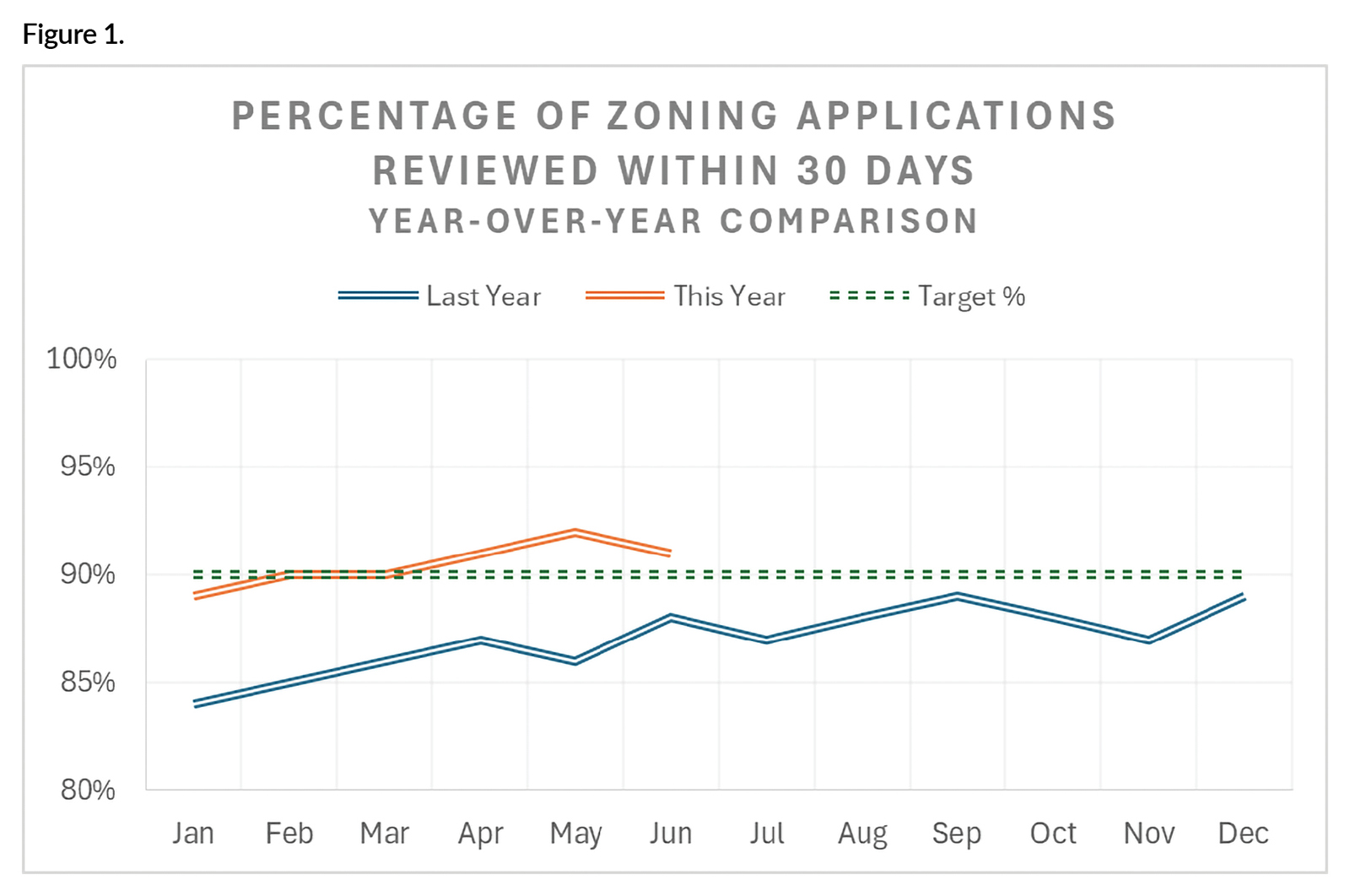
In the city of Roswell, Georgia’s rollout, initial KPI workshops brought together department heads and staff from across the organization. Led by the city’s planning, performance, and innovation team, these sessions emphasized clarity and outcomes rather than technical jargon. Once a KPI was established, the follow-up conversation became just as important: “What is your current performance in this area? What should it be? And why?” These probing questions encouraged leaders to set realistic targets, explain variances, and connect data to strategy.
This process not only promoted shared understanding but also created energy and ownership across departments. Staff saw that KPIs weren’t simply numbers to report, but tools to improve performance and demonstrate accountability to residents and council.
3. Embedding KPIs into Governance Processes
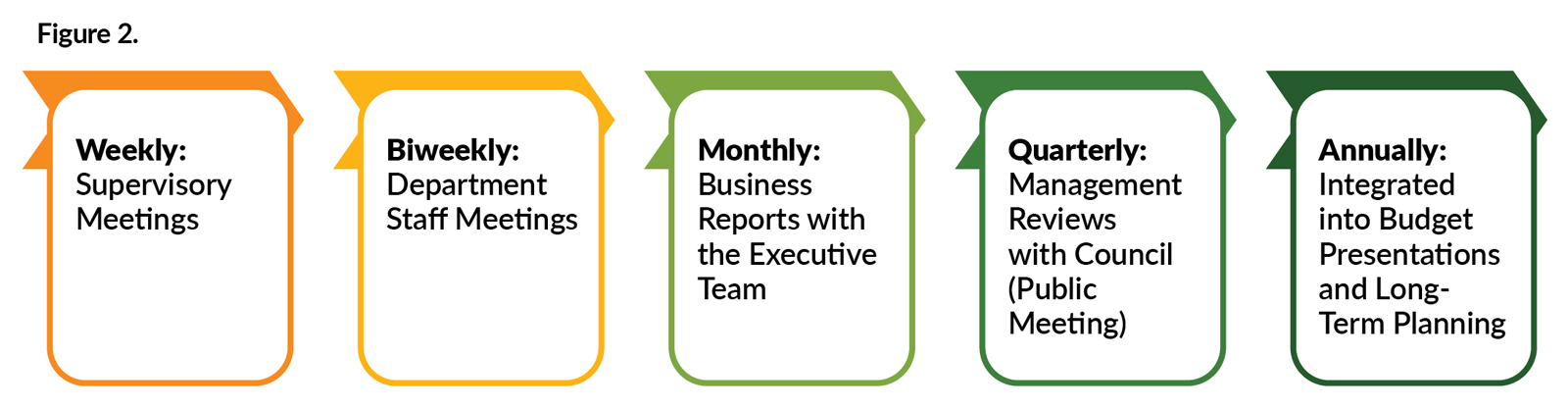
To truly harness the power of KPIs and drive meaningful impact, they must be seamlessly woven into the fabric of your organization’s governance and management routines. This proactive approach ensures continuous performance enhancement through consistent review and strategic alignment. Consider the following engagement points:
• Weekly: Supervisory meetings focusing on actionable insights.
• Biweekly: Collaborative department staff meetings fostering accountability.
• Monthly: In-depth business reports shared with the executive team for informed decision-making.
• Quarterly: Transparent management reviews with council (presented in a public meeting) to foster trust and community involvement.
• Annually: Integration of key KPIs into budget presentations and long-term planning sessions to shape future success.
By embedding KPIs into these pivotal touchpoints, you can empower your organization to stay agile, transparent, and relentlessly focused on achieving strategic goals.
Think of a quarterly report highlighting a fire department’s 42-second reduction in response time or a community park project at 65% completion. These aren’t just statistics; they are vital insights that guide resource allocation, sharpen strategic focus, and demonstrate accountability.
When KPIs are embedded into legislative processes, elected officials gain clear, compelling metrics that inform decisions and build confidence. Done well, this moves beyond routine management and becomes transformational leadership that drives transparency, agility, and excellence across the organization.
4. Turning Data Challenges into Strategic Success
The Challenges Faced
Like many municipalities, Roswell had no shortage of data, but much of it was buried in desperate technical systems that made extraction and visualization difficult. Some departments lacked KPIs altogether, while others tracked dozens of measures without clarity on which ones truly mattered. The result: leaders were overloaded with information but under-informed when it came to making decisions.
Turnaround Strategy
We adopted a simple principle: less, but better. Each department focused on identifying three to five core KPIs that best reflected service performance and outcomes. We standardized reporting templates, ensuring that data could be rolled up seamlessly for the executive team, and incorporated into quarterly management reviews with the mayor and council. This structure kept attention on the most meaningful measures while reinforcing consistency across departments.
The Early Wins
Although the rollout had its challenges, the impact was clear: department directors began to see how their data connected to both organizational strategy and their teams. The executive team gained a clearer view of service gaps and successes, allowing for sharper resource allocation. Because the city council now received regular, structured performance updates, trust and accountability grew stronger, moving the conversation from feelings and anecdotes to evidence.
Why It Matters
Roswell’s experience shows that focused data strategies can turn complexity into clarity. The key is to make data usable for decision-makers, not just reportable for compliance. When leaders see the right metrics consistently and in context, it shapes better conversations and smarter policy decisions.
The Takeaway for Local Governments
Performance frameworks succeed when they move beyond spreadsheets and into governing conversations. By curating metrics with decision-makers in mind, securing organizational buy-in, and embedding KPIs into council-manager processes, local governments can turn data into a strategic asset. The payoff is real: more informed decisions, stronger council-manager trust, and a public that sees measurable progress on the priorities that matter most.

DR. JOE PENNINO is deputy city administrator of planning, performance, and innovation for Roswell, Georgia.
Publish with ICMA!
We’re searching for interesting and insightful stories that can help others learn a memorable takeaway to serve their communities better.
