As a Special Forces officer, I served in Baghdad as a liaison officer to the U.S. Army division responsible for the city. One enduring lesson was that success depended on more than what happened on the ground. Leaders also had to understand whom people trusted, how quickly information moved, and how actions could be interpreted within a changing information environment.
A documented 2006 incident involving U.S. special operations forces became an important lesson for later missions. Its aftermath influenced how we operated, especially when events could be reinterpreted, scenes altered, and competing narratives established before the facts were understood or communicated. It reinforced the importance of considering the information environment during operational planning, not only afterward.
During the operation, U.S. special operations and Iraqi forces engaged an armed group in a deadly confrontation in which several people lost their lives. After the forces departed, the circumstances surrounding those deaths quickly became part of a competing public narrative. Within about 45 minutes, weapons were removed and some remains were moved to create the appearance that those killed had been praying rather than participating in an armed confrontation. Images of the altered scene were distributed with allegations that American forces had entered a place of worship and killed peaceful civilians. That account reached the media before the force returned.1
The human cost should not be lost in the lesson that followed. People had died, families and communities would carry those losses long after the operation ended, and the competing accounts shaped how those deaths were understood. In moments like these, establishing an accurate record is not only an institutional responsibility; it’s also a matter of respect for those affected and for a public trying to understand what happened.
Fortunately, combat-camera personnel accompanied the force, and some soldiers also wore helmet-mounted cameras, creating a contemporaneous record before the scene was altered. That imagery became critical to understanding what had occurred, with the conclusion that it “made all the difference” during the investigation.2 The lesson is similar to what local governments have learned from police body-worn cameras. A camera cannot resolve every disputed fact or capture every piece of context, but it can preserve an independent record before memories fade, evidence changes, or competing accounts become established. More importantly, it demonstrates the value of building documentation and accountability into operations from the outset.
Yet preserving the record is only part of the challenge. Briefing materials were assembled within hours, but approval processes kept them from public release for almost 70 hours. The operations officer involved later put it plainly: “It took us three days. That’s our fault.”3
That is where the connection to local government becomes clear. Public trust depends not only on whether government has a factual record, but on whether it can verify and communicate that record while people are still forming judgments. Meeting videos, staff reports, police footage, inspection records, and technical studies may establish what happened, but if they are difficult to find or arrive too late, their ability to strengthen trust is diminished.
Residents also judge the institution and the messenger. Research shows that perceived expertise and trustworthiness affect how people distinguish accurate from false information.4 The question is not simply, “What are the facts?” but also, “Who should explain them, and what evidence can residents verify?” Trust is strongest when institution, messenger, and evidence reinforce one another.
This challenge is growing as residents encounter civic information through social media, search engines, neighborhood networks, and AI-generated content, often without visiting a municipal website.
This is where generative engine optimization, or GEO, becomes relevant. In simple terms, GEO structures reliable online information so generative AI systems can more easily find it, understand it, attribute it to the correct source, and use it when answering questions. Research indicates that authoritative citations, statistics, quotations, and clear structure can improve source visibility in generative-engine responses.5
For local government, GEO is not about manipulating an algorithm. It’s about making authoritative information easier for people and AI systems to discover and verify. Meeting minutes and videos, budgets, staff reports, technical studies, datasets, policies, and other public records should form an accessible evidentiary record connected to the decisions they support.
My doctoral research examines whether evidence-transparent municipal communication can build on these principles by pairing factual claims with primary evidence, source documentation, and decision-making rationale so residents can independently evaluate what government tells them.
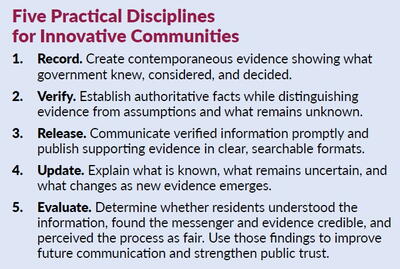
Taken together, the lesson from Baghdad and the challenges facing local government today point to a broader principle: trust is strengthened when organizations create a reliable record, verify what they know, communicate it promptly, and update that record as new information emerges. For local government leaders, that principle can be translated into five practical disciplines, found in the box on this page.
One lesson I carried from special operations into local government is that technology is not the strategy; it helps well-led organizations carry out strategy more effectively. Local government cannot control the information environment, nor should it try. It can perform well, preserve the record, communicate through credible people, make reliable evidence discoverable, and let residents evaluate it for themselves. That is how we build a government worthy of being believed and trusted.
DARRIN K. TANGEMAN, ICMA-CM, is chief financial officer for Orleans, Massachusetts, and co-founder of ICMA’s Veterans Local Government Management Fellowship.
Endnotes and Resources
1 Dauber, C. E. (2009). The truth is out there: Responding to insurgent disinformation and deception operations. Military Review, 89(1), 13–24.
2 Ibid.
3 Ibid.
4 Prike, T., Butler, L. H., & Ecker, U. K. H. (2024). Source-credibility information and social norms improve truth discernment and reduce engagement with misinformation online. Scientific Reports, 14, Article 6900.
5 Aggarwal, P., Murahari, V., Rajpurohit, T., Kalyan, A., Narasimhan, K., & Deshpande, A. (2024). GEO: Generative engine optimization. Proceedings of the 30th ACM SIGKDD Conference on Knowledge Discovery and Data Mining.
Publish with ICMA!
We’re searching for interesting and insightful stories that can help others learn a memorable takeaway to serve their communities better.
