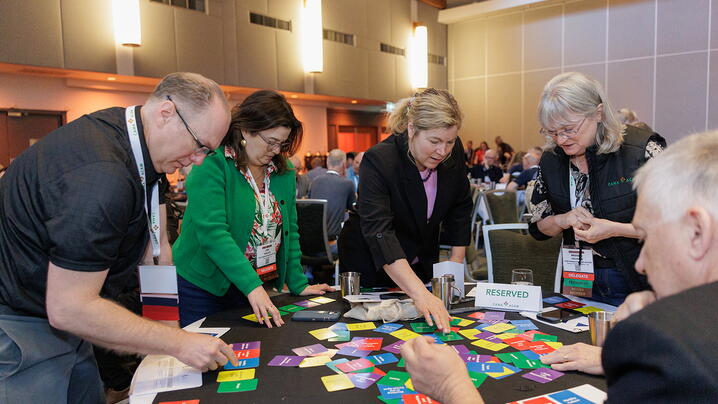
Incivility was not a new topic for CAMA. For years, municipal administrators had shared stories of difficult interactions, strained relationships, and increasingly challenging workplace dynamics. However, during CAMA's 2025 Annual Conference in Mont-Tremblant, Québec, it became clear that the issue had reached a new level of urgency.
Throughout the conference, chief administrative officers (CAOs) from communities large and small spoke openly about deteriorating relationships at the council table, disrespectful behavior toward staff, public criticism, online harassment, and increasingly polarized conversations within their communities.
What struck us most was the consistency of these experiences. Whether a municipality served 2,000 residents or 2 million, leaders across Canada were describing many of the same challenges.
As the national association representing more than 1,000 municipal administrators, CAMA recognized that this was not an isolated issue. It was a growing leadership challenge affecting local governments across the country, one that required more than acknowledgment. It required action.
Listening Before Leading
One of the first lessons we learned was that we could not solve a problem we did not fully understand.
Rather than immediately developing resources, we began by listening.
Through national think tanks, conference discussions, member surveys, peer forums, and one-on-one conversations, we engaged municipal administrators from every region of Canada. We also sought perspectives from mayors, councillors, governance experts, and former municipal leaders. Together, these conversations reinforced an important reality: incivility is rarely a single-person problem. More often, it reflects broader challenges related to governance, communication, trust, and leadership.
Their insights helped us better understand the challenges from multiple viewpoints and reinforced an important reality: incivility is rarely a single-person problem. More often, it is a symptom of broader issues related to governance, role clarity, communication, trust, and leadership.
What emerged was a clear message: municipal leaders needed practical support.
Moving Beyond Awareness
Too often, discussions about workplace challenges stop at awareness.
CAMA wanted to move beyond simply identifying the issue.
The association launched a national initiative focused on strengthening governance, supporting respectful workplaces, improving CAO-council relationships, and helping municipal leaders navigate increasingly complex environments.
Healthy debate is fundamental to local democracy. Our goal was to help leaders manage disagreement in a way that remained respectful, professional, and productive.
To achieve this, we brought together more than 70 municipal leaders from across Canada to contribute their experiences, insights, and expertise. Their collective knowledge became the foundation for a growing suite of practical leadership and governance resources designed specifically for local government.
Creating Practical Tools for Real Challenges
What began as a conversation about incivility quickly evolved into a broader effort to strengthen governance and leadership capacity across the municipal sector.
One of the cornerstone resources was the Standing Strong Toolkit: A CAO’s Guide to Maintaining Professionalism Amidst Incivility, a practical guide designed to help leaders recognize, address, and respond to uncivil behaviour while protecting workplace culture and organizational effectiveness.
However, we quickly recognized that incivility rarely exists in isolation. Many of the challenges members described were connected to role confusion, governance issues, unclear expectations, weak onboarding processes, and strained relationships between elected officials and administration.
As a result, the initiative expanded beyond a single toolkit to include a broader suite of governance resources such as Drawing the Line: When CAOs Must Act to Address Incivility and Protect the Organization, an updated Council Orientation Toolkit, the Council Governance Playbook, A Chairs’ Guide to Leading Effective Council Meetings, A Resident's Guide to Services, Roles and Good Governance, and a series of practical resources focused on respectful dialogue, decision-making, governance foundations, and role clarity.
Most importantly, these resources were grounded in the lived experiences of municipal leaders who face these challenges every day.
Creating Space for Honest Conversations
While the resources have been valuable, one of the most important outcomes of the initiative has been the conversations it created.
For many municipal leaders, simply hearing others describe similar experiences was powerful.
The conversations also helped shift the narrative.
Rather than viewing incivility as a personal failure or an unavoidable part of the profession, municipal leaders began discussing it as an organizational challenge that can be addressed through better governance, stronger relationships, clearer expectations, and more effective leadership practices.
The dialogue reinforced another important lesson: resilience matters, but resilience alone is not enough.
Organizations must also create structures, policies, cultures, and governance practices that support respectful interactions and protect the well-being of staff.
Lessons Learned
Looking back, several key lessons stand out.
First, difficult conversations matter. By creating safe spaces for municipal leaders to share experiences openly, we were able to identify challenges that might otherwise have remained hidden.
Second, practical resources have tremendous value. Municipal leaders are looking for tools they can immediately apply within their organizations.
Third, governance and civility are deeply connected. Many workplace challenges can be prevented or reduced when roles are clearly defined, expectations are understood, and relationships are built on trust and respect.
Fourth, peer networks remain one of the most powerful forms of professional support. There is significant value in knowing that others understand the unique realities of local government leadership.
Finally, addressing incivility is not about avoiding disagreement. Local government thrives on diverse perspectives and healthy debate. The objective is to ensure that disagreement remains focused on issues rather than individuals and that discussions occur in a manner that reflects professionalism and respect.
The Work Continues
The challenges facing municipal leaders are unlikely to disappear.
Yet there is reason for optimism.
Across Canada, local government leaders continue to demonstrate remarkable professionalism, resilience, and commitment to public service. Organizations are investing in stronger governance practices. Elected officials and administrators are engaging in more meaningful conversations about their shared responsibilities, and municipalities are becoming increasingly intentional about creating respectful workplace cultures.
For CAMA, perhaps the most important outcome of this journey is that the conversation has changed.
What was once discussed quietly behind closed doors is now being recognized as a leadership challenge worthy of national attention, meaningful dialogue, and practical action.
By bringing municipal leaders together, listening to their experiences, and developing resources grounded in real-world challenges, CAMA has helped move the conversation from awareness to action. While the work continues, municipal leaders across Canada now know they are not facing these challenges alone.
Interested in learning more? Check out the resources below that CAMA has made available for managers to consider as they continue to face the challenges of incivility and work to create stronger governance practices:
- How to Build a Successful Council Orientation: Building Strong Governance, Relationships and Respectful Decision-Making
- Charting Your Course: A Leadership Toolkit for Municipal CAOs
- Your Local Government: A Resident’s Guide to Services, Roles & Good Governance
- Drawing the Line – When CAOs Must Act to Address Incivility and Protect the Organization
- Quiet Leadership Tool for CAOs: Using Storytelling & Visuals to Support Good Governance and Reduce Tension
- Transparency, Fair Process, and Fair Treatment at the Council Table
- Leading Effective Council Meetings: A Practical Guide for Mayors & Chairs
Publish with ICMA!
We’re searching for interesting and insightful stories that can help others learn a memorable takeaway to serve their communities better.
