In today’s digitally immersed world, where 85% of Americans are online daily and spend nearly six hours consuming information, local governments face both a multilayered challenge and an exciting opportunity. Traditional media is shrinking at a rapid pace: newspapers are closing, local news coverage is fading, and more than half of Americans now get their news from social platforms. For local governments, this shift opens a powerful door: the ability to communicate directly, authentically, and consistently with the very residents they serve.
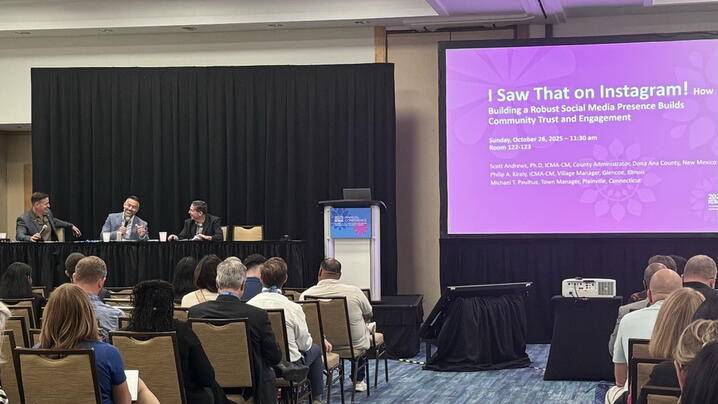
That core idea—with all its promise, hurdles, and transformative potential—served as the foundation for the ICMA Annual Conference session “I Saw That on Instagram! How Building a Robust Social Media Presence Builds Community Trust and Engagement.” Led by Scott Andrews, ICMA-CM, Ed.D., and CEO/county manager of Doña Ana County, New Mexico; Philip Kiraly, ICMA-CM, MPA and village manager of Glencoe, Illinois; and Michael Paulhus, town manager of Plainville, Connecticut, this impactful session unpacked how social media can build trust, strengthen engagement, humanize local government, and deliver information where people already are.
Understanding the Impact of Social Media on Trust and Engagement
Social media is far more than a communications tool for local governments, it’s a trust-building engine. In this age of skepticism and polarizing online narratives, trust is the new currency of local government. As the speakers emphasized, trust is fragile. It takes years to build, but can collapse in seconds, especially online. Social media gives local governments the ability to anchor themselves as the trusted, transparent source residents turn to for accurate information. Scott Andrews highlighted how consistency plays a major role:
“Consistency builds credibility.”
Posting regularly, showing real employees doing real work, sharing timely updates, and staying visible, especially during crises, helps residents see their government as accessible and dependable.
The key to building such trust: overcoming fear. The speakers pointed out that fear is often what holds local governments back from posting. Fear of trolls, fear of criticism, fear of mistakes, and fear of missteps that spiral into public backlash all contribute to local governments' hesitancy to have a stronger online presence. Despite these fears, one thing to keep in mind is that silence doesn’t stop criticism, it only amplifies it. When local governments fail to tell their own stories, others (including trolls) will gladly fill the void. By proactively communicating through thoughtful updates, behind-the-scenes videos, myth-busting posts, and simple everyday moments, local governments can reclaim the narrative and build goodwill long before controversy strikes.
One of the most compelling cases for building a consistent social media presence is for keeping your community calm and informed when emergencies arise. Social media serves as a trust accelerator during emergencies. If your community already follows you, trusts you, shares your content, and engages with your updates, then your emergency communications will move faster and farther when it matters most. That trust is the result of consistent, proactive storytelling long before the crisis hits.
Designing Practical Approaches to Content Development and Distribution
Your Phone Is Enough
Local governments can design and implement practical, realistic approaches to content, especially when time, staff, or political dynamics feel like barriers. And such content doesn’t need to be complicated. Across all three speakers, one message was loud and clear: Your phone is enough, and sophisticated equipment is optional, not required. A simple smartphone, paired with a little creativity and consistency, can deliver content that reaches thousands. In Glencoe, Illinois, Philip Kiraly’s “Office Hours with Phil” series uses nothing more than an iPhone, a free teleprompter app, a few minutes of filming, and a little bit of AI-assisted script writing. This simple system produces clear, educational short videos that residents can watch in one to three minutes.
Video Is King
When planning content development and distribution that will yield both trust and engagement, always remember, video is king. As Michael Paulhus emphasized, video is the fastest and most effective way to build trust. Residents want to see their public works crews prepping for storms, their mayor or manager explaining ordinances, their librarians preparing for summer reading, their parks staff maintaining fields, or their police officers sharing safety information. Video humanizes local government in a way text never can. And if it’s fun, even better! Paulhus’s now-famous “jumping into the pool in a full suit” video sparked enormous engagement and made local government feel truly relatable.
The Three Markers of Content Success
Be informative, educational, and, when appropriate, entertaining. If your content hits two out of these three, you’re doing well. If it hits all three, you’ve struck gold. The best way to hit all three of these markers is to ensure your content teaches something, provides value, shows the human side of local government, has a hook in the first three seconds, and is consistent. While coming up with new content ideas in an effort to stay consistent might sound difficult, the speakers repeatedly emphasized that there is no shortage of content opportunities in your organization; every department has stories worth telling.
Build Your Team, Gain Buy-In
When developing and deploying content, its important to build a team, even a small one. For this, you don’t need a giant communications department. You just need one champion to lead the effort, a few staff members willing to participate, and a leadership team that supports it. Keep in mind that employees should not be forced in front of the camera—but many will volunteer once they see positive feedback on early posts. Furthermore, it is crucial that elected officials both understand and support your content strategy so storytelling can come from the right voices at the right times.
Understanding Different Platforms, Audiences, and Content Types
Understanding platform culture, content types, and the importance of meeting residents where they are, are all essential to executing a successful social strategy. Keep in mind that not all platforms serve the same audience. The speakers asked the audience how many of their jurisdictions only use Facebook. Many hands went up, but as they pointed out, different demographics live on different platforms:
- Facebook → older audiences.
- Instagram → millennials, parents, young families.
- TikTok → Gen Z and early-career residents.
- YouTube → universal reach; great for long-form content.
If your goal is recruitment, for example, relying solely on Facebook is a losing strategy. Platform-specific strategies matter because each platform has its own culture, tone, and content style. While TikTok expects short, high-energy, creative videos, Instagram leans heavily on Reels and high-quality visuals. And while Facebook works well for detailed updates and older audiences, YouTube supports full-length educational pieces or livestreams. The key? Adapt the message to the platform.
Real-World Success Stories
All of this is not just theory, each speaker shared compelling examples of how social media led to real, measurable outcomes for their organizations.
Plainville, Connecticut: $62 Million School Referendum Campaign
Through strategic storytelling, videos featuring teachers, and resident-focused content, the town saw overwhelming support: A nearly four-to-one vote in favor of the project. That result would not have been possible without social media.
Glencoe, Illinois: Demystifying Local Government
Kiraly’s “Office Hours” video series has become a trusted information stream for residents curious about development, ordinances, and daily operations. Community surveys showed a 21% increase in positive ratings for the village’s social media presence after the program launched.
Doña Ana County, New Mexico: Transparent Communication on Major Projects
When a $160 billion data campus proposal generated heated debate, the county used social media for clear, consistent fact-sharing and timely updates—an essential step in maintaining trust during controversy.
Ten Takeaways to Add to Your Social Media Toolkit:
1. Proactive storytelling beats reactive damage control.
If you don’t tell your story, someone else will—and often inaccurately.
2. Consistency builds credibility.
Whether weekly or daily, pick a cadence and stick with it.
3. Video is the most powerful tool you have.
It’s authentic, engaging, and humanizing.
4. Human stories resonate most.
Showcasing employees, everyday moments, and behind-the-scenes glimpses are your best content.
5. Meet residents where they are, not where you’re most comfortable posting.
Expand beyond legacy platforms, don’t be afraid to try something new.
6. Social media strengthens emergency communication.
Build trust now so people turn to you later.
7. AI is a tool, not a replacement for authenticity.
Use it to assist your work, not to mimic your voice.
8. Don’t fear trolls or negativity.
They’re loud, but they’re not the majority.
9. Get internal alignment early.
Elected officials and department heads must understand and buy into your strategy.
10. Have fun.
Residents want to see the human side of government: joy, humor, personality, and heart.
Go Forth and Shape a Stronger Community Through Authentic Storytelling
Local governments that embrace proactive, authentic storytelling on social media are not just improving communication, they’re building trust, strengthening community, and positioning themselves as reliable, accessible partners in residents’ daily lives.
As the speakers demonstrated, you don’t need a massive budget or a Hollywood film crew. All you need is a phone, a plan, a little creativity, and the willingness to show up consistently. Because when local government communicates openly and authentically, residents don’t just stay informed, they stay engaged. They share your content, they stop you on the street to say, “I saw that on Instagram!”, and most importantly, they become partners in shaping the community you serve.
For more, listen to Michael Paulhus on ICMA's Voices in Local Government podcast:
Publish with ICMA!
We’re searching for interesting and insightful stories that can help others learn a memorable takeaway to serve their communities better.
