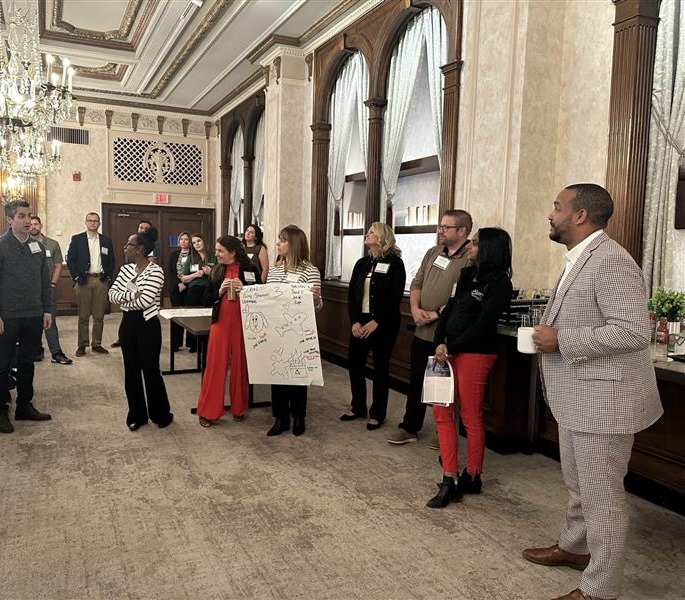
The 2025 Class of Leadership ICMA capstone projects showcase the creativity, insight, and practical leadership of emerging local government leaders committed to advancing the profession. Developed with a strong focus on the needs of small- and mid-sized communities, these projects offer timely, actionable resources that address the real challenges practitioners face every day. From strengthening organizational capacity and supporting workforce development to enhancing community engagement, collaboration, and service delivery, each team translated learning into solutions that can be adapted and applied across diverse local government settings.
These capstones reflect the best of Leadership ICMA: innovative thinking, peer collaboration, and a deep commitment to public service. More than academic exercises, they are practical tools designed to help local government professionals lead with confidence, respond to complexity, and better serve their residents. The following summaries highlight each team’s focus area, key deliverables, and meaningful contributions to building stronger, more resilient communities and a more connected local government profession.
- A Practical Guide to CIP Committees: Strengthening Capital Governance and Public Trust
A practical guide on how to establish and operate an internal CIP committee, which includes:
- Case-study-based documentation drawn from a local government organization
- Guidance focused on: Advancing transparency in capital improvement programming
- Aligning project selection with elected officials’ goals and community priorities
- Clearly communicating CIP project selection processes to decisionmakers and residents
- Tools and insights to support a more defensible, structured, and transparent approach to capital project selection in jurisdictions with mature CIP processes
Download the Guide to CIP Committees here.
Capstone Members:
- Brian Staley
- AI Practices: AI Scoring Matrix
The goal of the AI Scoring Matrix is to help local jurisdictions evaluate whether or not an AI tool is the best fit for them to address their need.
What's included:
- Evergreen evaluation framework designed to keep pace with rapid AI evolution
- 30‑point scoring system (pass/fail threshold)
- Evaluation criteria informed by responses to surveys and interviews with public‑ and private‑sector AI practitioners
- Web‑based, interactive tool (HTML generated using Microsoft Copilot)
- Training video that explains:
- How to use the scoring matrix to evaluate the AI software being considered.
- Legal, ethical, data privacy, and workforce considerations
- Susana Carbajal
- C.J Heaton
- Corey Costello
- Capital Improvement Program (CIP) Toolkit
Capital Improvement Program (CIP) Toolkit designed for small communities (less than 150,000 residents)
- Rolling 10‑year Capital Improvement Program framework focused on assets valued at $50,000 and above
- CIP example policy
- Six templates / worksheets, including: Project readiness review checklist (site control, engineering, permitting, cost estimates, funding sources)
- Internal project charter (internal planning document)
- One‑page public‑facing project summary for budget submission
- Standardized evaluation criteria to support: Objective project prioritization (public safety, asset condition, service impacts, strategic alignment)
- Toolkit intended to help communities move away from reactive, ad‑hoc capital decision‑making
Download the Capital Improvement Program Toolkit here.
Capstone Members:
- Matthew Graham
- Brian MacDonald
- Civic Assemblies: An Answer to Our Toughest Problems
A practitioner’s guide titled "Civic Assemblies: An Answer to Our Toughest Problems"
- Designed around three case studies:
- Montrose, CO – child care shortages
- Fort Collins, CO - addressing a land‑use issue that advanced to the ballot
- Seattle, WA – climate resilience, clean air and energy transition, and economic equity
- Guidance on:
- When civic assemblies are an appropriate engagement tool
- Key elements of successful civic assemblies
- Lessons learned from real-world applications
- Adaptations for smaller or resource‑constrained communities
Download the Guide to Civic Assemblies here.
Capstone Members:
- Sammara Green
- Michelle Bowers
- Tiesha Mosley
- Rupa Venkatesh
- Joe Walsh
- Jill Wolf
- Designed around three case studies:
- Data Culture Toolkit
The Data Culture Toolkit is focused on building and sustaining a data‑informed organizational culture, particularly for small‑ and mid‑sized jurisdictions. The Toolkit is organized around six core areas:
- Leading a data culture shift
- Data literacy fundamentals
- Trust and transparency
- Equity in data use
- Building a strategic data plan
- Staff engagement and equitable decision‑making
- Also included:
- Embedded, practical templates linked throughout the toolkit
- Survey of approximately 70 local government professionals to inform toolkit design
- Two webinars included from the "Data in the City" webinar series:
- Webinar #1 features a small city, West Hollywood; a mid-size city Savannahl and a large city Philadelphia
- Webinar #2 features an interview with Harvard Bloomberg Data Fellows on applied data work in Savannah
Download the Data Culture Toolkit here.
Capstone Members:
- Jackie Rocco
- Jennifer Blalock
- David Irizarry
- Emergency Management 101: A Toolkit for Small Communities
This Emergency Management toolkit is intended to provide a clear starting point for communities that may not have dedicated emergency management staff, offering accessible guidance, adaptable templates, and links to key resources.
- A narrative emergency management framework
- Three chapters (pre‑disaster, during disaster, post‑disaster)
- Appendices that include:
- curated documents
- critical forms
- Links to dozens of templates and trainings
- Intended as a living toolkit for small communities
- The group is planning to work on an article for PM Magazine.
Download the Emergency Management toolkit here.
Capstone Members:
- Jorge Chamorro
- Ashley Bernal
- Molly Fitzpatrick
- Patrick Jones
- Five-Star City Government: Enhancing Customer Experiences with Municipal Services
Customer Service Playbook that includes:
- Interactive PDF
- Four core pillars of customer service
- Standardization and standard operating procedures
- Access to information and internal knowledge systems
- Professional training and staff development
- Feedback loops and continuous reporting
- Practical, “pull‑off‑the‑shelf” strategies that departments or organizations can implement independently
- Guidance adaptable to different stages of community growth
- Recognitions, awards, and programs that exemplify excellent customer service
Download the Customer Service Playbook here.
Capstone Members:
- Jessica Carpenter
- Jessica Clarke
- Anthony Armstrong
- Jennifer Arnold
- Kristen Gorham
- Leadership ICMA: Finish Strong
While most Capstone Projects result in tangible products or services, the Leadership ICMA: Finish Strong capstone team focused on process: how to adapt, redesign, and build connection in real time; and delivered a capstone experience that reflected the heart of servant leadership. By centering the needs, experience, and long-term connection of their cohort, they created a thoughtful, energizing close to the Leadership ICMA program. Their work stands out for its care, creativity, collaboration, and lasting impact—making this project an example of the excellence represented among the 2026 capstone projects.
Local Government Leaders of every ilk can learn from their example by recognizing the power of listening closely to needs, being willing to adapt the project scope when a stronger opportunity emerges and designing experiences that are both purposeful and personal. Their work reminds us that leadership is not only about completing projects, but also about creating meaningful connections, honoring the journey, and leaving participants with tools, memories, and relationships that continue well beyond the program.
Their accomplishments included:
Designing and coordinating a meaningful three-day, in-person Leadership ICMA event that brought the cohort together to close out the program with intention, celebration, and purpose.
Thoughtfully reframing the program scope, prioritizing connection, cohort experience, and a strong sense of closure in a way that honored the participants’ full Leadership ICMA journey.
Using Leadership ICMA assessment results to identify shared strengths and growth areas, transforming data into meaningful insight for the benefit of the entire cohort.
Developing a strong, well-structured multi-day agenda that encouraged reflection, engagement, continued learning, and celebration.
Creating welcoming and memorable cohort engagement materials, including:
Swag bags that added a personal, celebratory, and thoughtful touch
A virtual yearbook with photos and contact information to help the cohort stay connected well beyond the program
Coordinating graduation efforts, program completion, and post-program connection with care, consistency, and commitment.
Capstone Members:
- Shannon Aulabaugh
- Michele Sanchez
- Devon Fields
- Tyler Deems
- Bobby Tech
- Off The Shelf and Into Action: The Strategic Plan Implementation
- PM Magazine article
- Survey of 59 local government professionals
- Synthesized findings on: Community engagement
- Measurable goals and accountability reported back to your community
- Organizational culture built around your strategic plan
Download the Strategic Plan Study here.
Capstone Members:
- Doug Ferrall
- Myles Tucker
- Stone James
- Lisa Wilson
- Demetrius Bynes
- Christina Cornwell
- The Housing Heroes Podcast Series
- Six‑part podcast series
- Episodes focused on distinct housing policy areas, including:
- Homelessness
- Supportive housing
- Gentrification
- Zoning reform
- Broader housing supply challenges
- Expert interviews with national and regional housing practitioners
- Listener reflection questions included at the end of each episode
The Bridging the Gap: Housing Heroes Podcast can be accessed on the following Platforms:
Capstone Members:
- Brian Hoben
- Seth Floyd
- David Gray
