
I am a police captain overseeing traffic and parking enforcement units in a mid-sized city in the northeast. We’ve been getting a lot of angry complaints from business people and neighborhood groups about people living in RVs parked along a mixed-use area of the city. Complaints involve trash, dumping of human waste, blocked sidewalks, and unsightliness. We have the authority to cite RVs that don’t move their vehicles every 72 hours. I realize that citing RVs and forcing them to relocate just moves the problem to another area of the city.
I’d like to propose a “safe parking” program on public property or in church or business parking lots. I realize that the homelessness problem is driven by larger economic and social forces, and any safe parking program won’t solve the problem. I also know that the police department can’t adequately address the challenge.
We do have a few shelters in the city operated by nonprofits or faith-based groups and some new subsidized affordable housing projects. These efforts are totally inadequate given the scope of the problem. Moreover, there is a lot of fear on the part of the unhoused as well as other community members.
There does not seem to be a good solution to create a better future for all. I feel for the RV folks who need the housing and for the business and community people who complain. It seems like a growing and overwhelming problem. Given my limited authority, I feel somewhat helpless. I want to do something but don’t know what. What do I do?
Yes, your assessment is correct. The unhoused challenge is part of larger social and economic forces that you cannot address. And your values compel you do something positive even though a safe parking program will undoubtedly be insufficient in solving the homelessness challenge. Yet, you must act. You are not helpless. As John Wooden famously stated, “Do not let what you cannot do interfere with what you can do.”
Three Reactions to Change
It is often suggested that leaders need to manage change. Peter Drucker, the great management thinker of the 20th century, stated that it is impossible to “manage” change. The mega-forces creating change are too big to manage.
In the face of a changing future, leaders have three options:
Shape the change
This is the best option. You see the change as it emerges and you do your best with others to embrace or acknowledge the change and shape it for the better.
Passively accept the change
This is the mindset of accepting whatever may occur. You feel helpless. It is not a good place to be.
Resist the change
This attitude is impossible. You cannot resist the change over time. The forces of change are too big. (It was like me as a young department head trying to resist the use of email in the early 1990s.)
So, the question is how to actively shape the change as it occurs and help create something positive with others.
Three Spheres
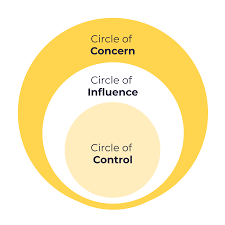
Stephen Covey, in his book The 7 Habits of Highly Effective People (1989), identified three spheres of involvement:
Circle of control: You can make things happen and deliver upon your commitments.
Circle of influence: You can guide and shape outcomes, but only indirectly and usually only partially.
Circle of concern: You may have an interest and may be impacted by what happens, but you have little control or influence.
With respect to the unhoused challenge, you do not have any control and can make few commitments. However, you do have some influence. You can engage the police chief and other senior leaders in the police department in discussing how to respond, convene staff from other departments, and start conversations with business and community stakeholder groups, including RV owners. As a result of the conversations, you can identify certain options, make recommendations, and then help implement any recommended action. In the process, you are shaping the future.
Shaping the Future
Here are some strategic ideas on helping to create with others a better future.
Start with Your Core Values
In the face of much potential pushback and resistance, you are taking a risk in suggesting a safe parking program. You don’t have any control of the outcome in making the proposal. You are likely to be fearful. However, it seems that you have core values of compassion and social justice. (See Career Compass No. 67: Effective Leaders Start with Compassion.)
You don’t take a big risk unless it aligns with who you are at your core.
If the risk aligns with your core values, you confront your fear and act anyway. (See Career Compass No. 39: The Courage to Do the Right Thing.) Moreover, you are more likely to persist in the face of opposition if the issue relates to your core values.
There are ways to mitigate the risks.
Acknowledge the Adaptive Challenge
To address any challenge, you must first acknowledge the nature of the challenge. Ron Heifetz and Marty Linskey, in their book Leadership on the Line (2002), identified two kinds of challenges.
Technical challenges are those problems where the solutions are known and can be addressed by management. A classic technical challenge is filling potholes. Through a pavement management program, public works management can identify the potholes and their severity, prioritize which ones get filled, request and receive funding, then assign work crews to do the work, and ensure that the work is done on time and on budget and it is quality work. Technical challenges are “tame” problems.
Adaptive challenges are those problems where the solutions are not known and only can be addressed by leadership. There are value conflicts galore and every stakeholder group has its own preferred solution. There are no right or wrong answers. Every group has the potential to veto or block your proposal. Adaptive challenges are “wicked” problems.
The challenge of RVs parked on city streets and providing housing for the unhoused is definitely an adaptive challenge. Data and technical solutions will not solve the problem. You need to convene the different stakeholders and start constructive conversations.
Cross boundaries
You cannot address an adaptive problem in your silo. You must cross boundaries within your police department and then cross boundaries outside the department and eventually engage people outside the city organization.
The problem is that when you cross a boundary, you have no formal management authority. You cannot force people to follow you. They must decide to follow you. That requires leadership influence.
Therefore, the key leadership question is how do you get to “yes” when everyone can say “no.”
Do the Research
Other local governments and their partners have attempted to address the challenge of RVs housing the unhoused. As a basis to start some needed conversations, you must do some research on how other local government agencies have addressed the challenge: what are some exemplary safe parking programs and other responses, what are some things that have worked, what has not worked, and what are some lessons learned from other programs.
You need to do this initial research and collect data. However, while this kind of research and evidence is necessary, it is inadequate and will not carry the day.
Start a Series of Conversations
As a leader, you must begin to reach out to other stakeholders inside and outside the organization. Given the nature of this adaptive challenge, you (and some other colleagues and interested volunteers) might want to first talk with individual group representatives in order to understand their needs, values, interests, and preferred solutions. Initially convening all the groups together may just exacerbate the conflict.
The goals of these individual meetings are to listen, understand, and acknowledge what is being shared with you, and most importantly, create relationship. Relationship and rapport must precede problem-solving.
These must be authentic conversations. You are not trying to get “buy-in” to your safe parking proposal. People will resist you seeking buy-in even if you have a brilliant idea. Buy-in is essentially manipulative and people can sense it immediately. Instead of buy-in, you are seeking the ideas of the different groups and trying to find ways to incorporate the ideas into the eventual proposal. You need everyone’s “fingerprints” on the program so it is not “your” proposal but “our” proposal.
It is not an authentic conversation unless you are willing to be changed by the conversation.
(See Career Compass No. 61: Leadership Is the Art of Conversation.)
Ask Catalytic Questions
Authentic conversations are generated by asking powerful questions, listening, and acknowledging what you hear.
To identify key values and perspectives, ask some of these “catalytic questions”:
- For you, what does success look like?
- How might we address this challenge?
- What else could we do? What are your ideas to address this challenge?
- What is a completely different approach to this problem?
- What are we missing? Who are we missing?
- How would your neighbors (or businesspeople or the RV tenants) react to this idea?
- What are we learning about this challenge? What don’t we know?
- What are your concerns? How could we mitigate those concerns?
- What are one or two steps forward?
- To be part of the solution, what are you willing to do?
Authentic conversations require a curious mind.
Reflect Upon Possible Areas of Convergence
You must reflect upon the different conversations. While business and neighborhood groups, nonprofit agencies and faith-based leaders may have different interests and values, your conversations will help identify areas of convergence. Neighborhood and business groups may want to remove the RVs. RV tenants might want a safer environment and certain facilities (restrooms, showers, laundry facilities). As part of their ministries, faith-based groups might want to support individuals and families who are homeless. Certain nonprofit agencies might see a safe parking program with supportive services (e.g., case management, permanent housing or health services) as an additional way to serve an at-risk population. Elected officials might want to minimize conflict among the groups.
Develop a Working Group
Through the initial set of conversations, you are able to identify individuals inside and outside of the city organization who are willing to seek a response to the RV challenge. You can convene the working group to review your research (better yet, have the group do the research), mull over ideas, identify resources and assets that groups can contribute (e.g., parking lots, services, volunteers, funding) and develop options. Team members are also responsible for communicating back to their groups any updates and progress along the way.
The purpose of the working group is to co-create a desired future.
Frame the Proposal Differently for Different Groups
Instead of seeking “buy-in” and getting resistance, you must intentionally “frame” the issue differently for different groups. A red frame brings out the red in a painting. A blue frame brings out the blue in the same painting.
The act of framing is communicating the proposal in such a way that the target group perceives the positive potential of the idea given their interests. The safe parking program can be framed for residents and business people as an effort to remove RVs from the streets. For faith-based groups, it can be framed as part of their ministries of love. For the police department, it can reduce calls for service and allows the police department to focus on criminal behavior. For RV dwellers, the program promotes their safety and provides needed services and perhaps a path to permanent housing.
Model Hope
In leading change for a better future, you must ask yourself: “How must I show up?”
Even though you may feel scared or at least anxious and uncertain, you must show up with hope. (See Career Compass No. 119: How to Create Hope in Scary Times.)
Hope is not just an optimistic feeling about the future. To hope is an action verb. Hope includes:
- Setting realistic, achievable goals.
- Identifying a path forward.
- Believing that you can make good things happen.
- Taking action and making adjustments.
- Tracking progress.
If you model hope as well calmness and steadiness, others will to tend to follow your lead.
Turn Stakeholders into Allies
Since there a lot of different departments and external stakeholder groups who have an interest in this challenge, you must seek out partners and allies. By convening stakeholder representatives, listening to their concerns, and incorporating their ideas as appropriate, you can turn stakeholders into partners. Typically, this process creates a more robust and elegant proposal.
Stakeholders can oppose you, even abuse you. Partners or allies may disagree with you but will struggle with you to find a positive path forward.
Allies can provide tangible resources:
- Ideas.
- Physical facilities.
- Access to their members.
- Funding.
- Volunteers.
- Political support.
Of all these resources, political support is perhaps the most critical. Opposing groups and elected officials can easily attack you as the leader. It is a lot more difficult to criticize you if you are standing shoulder to shoulder with neighborhood and business leaders and any nuns and rabbis. Allies spread the risk.
Take a Few Steps Forward
With the support of allies and partners, you can recommend to the city manager and city council a pilot safe parking program at a specific site, perhaps supervised by a nonprofit agency, with appropriate services and facilities. By calling the project a “pilot” (even if in your mind it isn’t a pilot), it is seen as “experimental” and thus “reversible.”
In an uncertain world, only action creates clarity about the path forward.
So, take a few steps forward, pivot as necessary, and most importantly learn as you go.
Do Pre-Mortems and Post-Mortems
As you proceed, you need to debrief. . .not just at the end of the project but along the way. These are post-action reports commonly conducted by public safety agencies. The three basic questions are:
- What is going well?
- What is not going well?
- What are we learning to improve our practice or project?
In addition to post-mortems of various kinds, I encourage you to conduct with your working group pre-mortems. Before any actual implementation begins, ask your team members to imagine that after 18 months of existence the safe parking program has failed. What happened along the way? What were the ingredients that led to big mistakes or failure? Once you have identified these mistakes, your team can re-engineer your program proposal and implementation plan to avoid or overcome the mistakes.
Co-Creating a Better Future for All
You cannot predict or control the future. The future is uncertain and “messy” as it unfolds. Yet, given your values, you must act to help shape the future for the better and co-create it with others.
Given that groups may block you and criticize you, leading people in shaping a better future is not easy and you have little control or authority. However, once you engage others, incorporate their perspectives, develop an even more robust idea and bring that idea to life, you can look back and feel gratified by contributing to a more positive future for all.

Sponsored by the ICMA Coaching Program, ICMA Career Compass is a monthly column from ICMA focused on career issues for local government professional staff. Dr. Frank Benest is ICMA's liaison for Next Generation Initiatives and resides in Palo Alto, California. If you have a career question you would like addressed in a future Career Compass, e-mail careers@icma.org or frank@frankbenest.com. Read past Career Compass columns.
The ICMA Coaching Program offers free one-to-one coaching to ICMA members. If you are an ICMA member, register on CoachConnect to choose a coach, and explore more Coaching Resources.
If you are a member of the Texas City Management Association, Illinois City/County Management Association or North Carolina City and County Management Association, you will continue to have access to the CoachConnect platform until the state partner coaching agreements expire. Contact your state association for further information.
Publish with ICMA!
We’re searching for interesting and insightful stories that can help others learn a memorable takeaway to serve their communities better.
