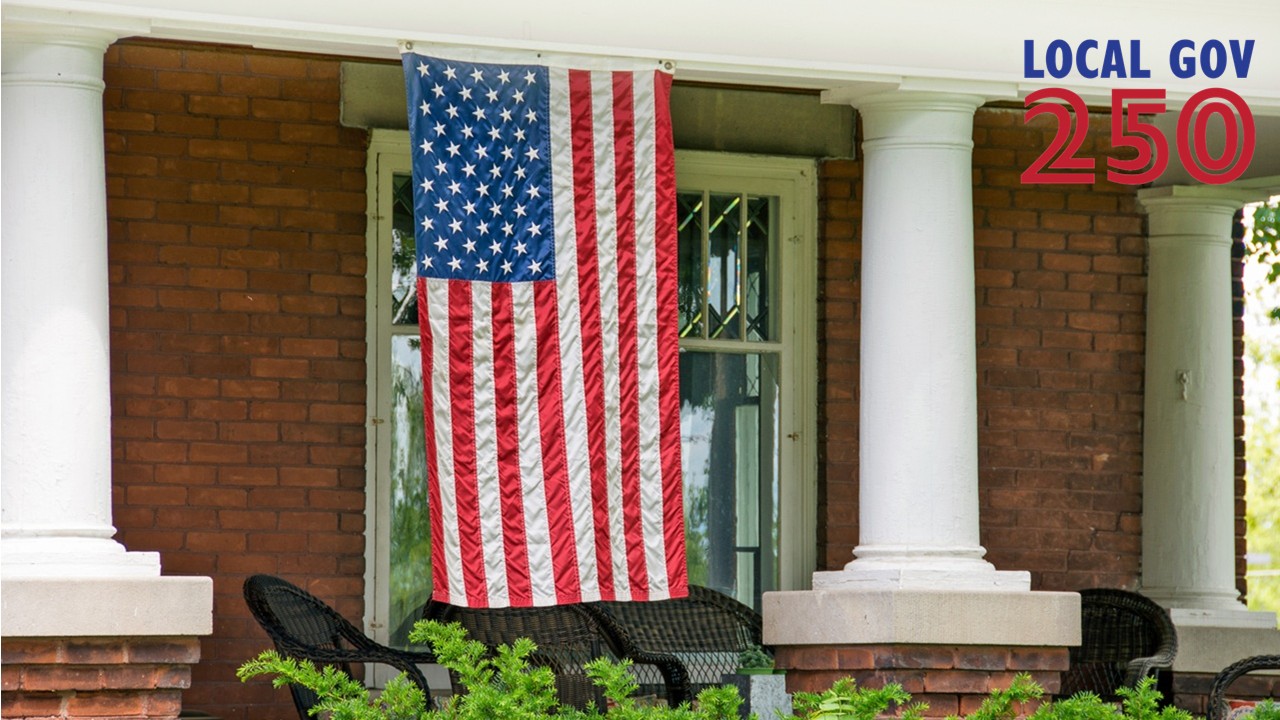
In 2026, the United States will commemorate 250 years since the signing of the Declaration of Independence. Anniversaries of this magnitude invite us to reflect on the ideals that shape our nation, but they also challenge us to examine how those ideals are lived today, in real communities, by real people, facing real constraints.
For most Americans, democracy is experienced locally. It is shaped by everyday interactions with public servants: when a resident attends a public meeting for the first time, when a small business owner navigates a permitting process, when a family relies on safe roads, clean water, and responsive emergency services. Democracy, for most people, lives at the doorstep.
Local government is the front porch of American democracy. It is where lofty principles meet operational reality, where trust is built incrementally, and where legitimacy is either reinforced or eroded one interaction at a time.
Where the Democratic Experiment Lives
Much of the American democratic experiment has unfolded not through sweeping national moments, but through the daily work of cities, counties, towns, townships, and tribal governments. While local governments are not explicitly outlined in the nation’s founding documents, they have long served as democracy’s most immediate expression.
Local governments deliver the services that make modern life possible. Public meetings, advisory boards, community townhalls, and elections are not symbolic gestures. They are the mechanisms through which residents engage, challenge, and shape their communities. When these processes function well, democracy feels responsive. When they do not, public trust suffers. Local government professionals are not observers of democracy. We are its daily stewards.
A Profession Built on Proximity and Trust
Local government differs from other levels of governance in one essential way: proximity. Residents often know where city hall is. They know who to call. They recognize staff members in the grocery store or at youth sporting events. That closeness creates accountability, but it also creates opportunity. Proximity allows local governments to respond quickly, tailor solutions, and engage residents meaningfully. It also means that missteps are visible and personal. There is no abstraction layer. Trust is built face to face.
Over the course of my career, spanning more than 23 years and multiple states, I have come to understand that credibility in local government is cumulative. It is earned through consistency, transparency, and followthrough. People may disagree with decisions, but they are far more likely to accept outcomes when they believe the process is fair and respectful. This is where democracy either strengthens or frays.
From Recreation to the County Manager’s Office
My own path into local government leadership was neither linear nor inevitable. I began my career in recreation, drawn to the belief that public spaces and shared experiences matter. Over time, I served in a range of local government roles across different regions and organizational cultures. Along the way, mentors invested in me, even early on when there was little reason to do so. They taught me that leadership is not about visibility, but responsibility. Not about certainty, but judgment. Not about authority, but trust.
Those lessons shaped a personal leadership mantra that has guided me throughout my career: Work for the cause, not the applause. Live life to express, not to impress. Don’t strive to make your presence noticed. Just make your absence felt. In local government, leadership is rarely loud. It is steady. It is relational. It is defined by what continues to function well when no one is watching.
Leading with Love as a Professional Discipline
The idea of leading with love can sound misplaced in a profession often defined by technical rigor, fiscal discipline, and legal compliance. Yet in practice, love is not sentimental. It is disciplined and demanding. To lead with love in local government means committing to dignity as a baseline. It means listening with the intent to understand, not simply to respond. It requires balancing accountability with compassion, and efficiency with equity.
Love shows up in how public meetings are facilitated, especially when emotions run high. It shows up in how staff explain complex or unpopular decisions. It shows up in how organizations design systems that work not just for the most vocal, but for the most vulnerable. This approach does not lower standards. It raises them.
Research on trust in public institutions consistently points to procedural fairness, transparency, and relational competence as key drivers of legitimacy. Local governments are uniquely positioned to operationalize these principles because of their scale and proximity.
In this sense, emotional intelligence is not a “soft skill.” It is core infrastructure for democratic governance.
Democracy in Practice: A Local Perspective from Doña Ana County
Today, I serve as county manager for Doña Ana County, New Mexico, a geographically expansive and culturally rich community along the U.S.–Mexico border. The county spans more than 3,800 square miles and includes urban centers, rural communities, agricultural lands, and tribal neighbors. Our residents bring diverse histories, languages, and expectations to the table. What unites them is a desire to be heard, respected, and served with integrity.
Early in my tenure, we held a public meeting on a complex issue with no easy answers. Emotions were high. Residents came prepared not just with comments, but with lived experiences shaped by decades of policy decisions. The temptation in moments like this is to manage the meeting tightly, minimize discomfort, and move quickly toward a conclusion.
Instead, we slowed the process.
We listened longer. We allowed space for frustration without defensiveness. We acknowledged uncertainty where it existed. We committed to follow-up and transparency, even when the path forward was not fully formed. That meeting did not resolve every concern. It did not produce unanimous agreement. But it did something equally important. It reinforced trust. Residents left knowing they had been taken seriously. That is democracy at the doorstep.
The Moments that Shape Civic Identity
The health of democracy is rarely determined by singular events. It is shaped in the cumulative moments between formal decisions: How staff respond to a phone call. How accessible information is. How conflict is handled when stakes feel personal. These interactions may seem operational, but they are profoundly civic. They influence whether residents feel alienated or engaged, cynical or hopeful.
Local government professionals are, in many ways, translators. We translate policy into practice, community values into action, and conflict into compromise. That translation requires technical competence, but it also requires emotional fluency. When residents feel seen and respected, even in disagreement, democratic norms are reinforced. When they feel dismissed or unheard, those norms erode.
Preparing for the Next 250 Years
As the nation looks ahead to its next 250 years, local government faces both opportunity and responsibility. Technological change, artificial intelligence, demographic shifts, climate adaptation, and fiscal pressures will reshape how communities operate. Yet amid these changes, one truth remains constant. Democracy depends on relationships.
Efficiency without empathy will not sustain trust. Innovation without inclusion will not build legitimacy. Data without discernment will not inspire confidence. The future of local government leadership will require a dual fluency. Leaders must be technically capable and deeply human. They must understand systems and stories, metrics and meaning.
Why This Work Is Personal
Like many public servants, I bring my full humanity into this work. Life experiences, including profound loss and moments of deep personal recalibration, have clarified my understanding of purpose. They have taught me that people remember how leaders show up during difficult moments. They remember whether decisions were made with humility, honesty, and care.
An Invitation to the Profession
As we commemorate America’s 250th anniversary, local government professionals have a unique opportunity to help shape the narrative of democracy at the ground level. Not through grand gestures, but through everyday acts of service carried out with integrity. Democracy does not begin with a speech. It begins with a conversation. Often at a counter. Sometimes in a council chamber. Always at the doorstep.
If the next 250 years of American democracy are to be strong, they will be built the same way the first 250 were built, through people willing to serve with competence, courage, and care. That is the quiet power of local government. It is a legacy worth protecting.

DR. SCOTT ANDREWS, ICMA-CM, is county manager for Doña Ana County, New Mexico, USA.
Learn More about Local Gov 250
In collaboration with other local government associations, ICMA is commemorating America’s 250th anniversary by celebrating the “democracy at the doorstep” facilitated by cities, counties, regional councils, and tribal governments. Learn more at localgov250.org
Call for Content: ICMA is seeking any content that you may have that connects and celebrates local government and its role in democracy. Written content may be used as feature pieces in PM magazine, enewsletters, or modified into podcasts. For submissions and questions, contact research@icma.org.
Publish with ICMA!
We’re searching for interesting and insightful stories that can help others learn a memorable takeaway to serve their communities better.
