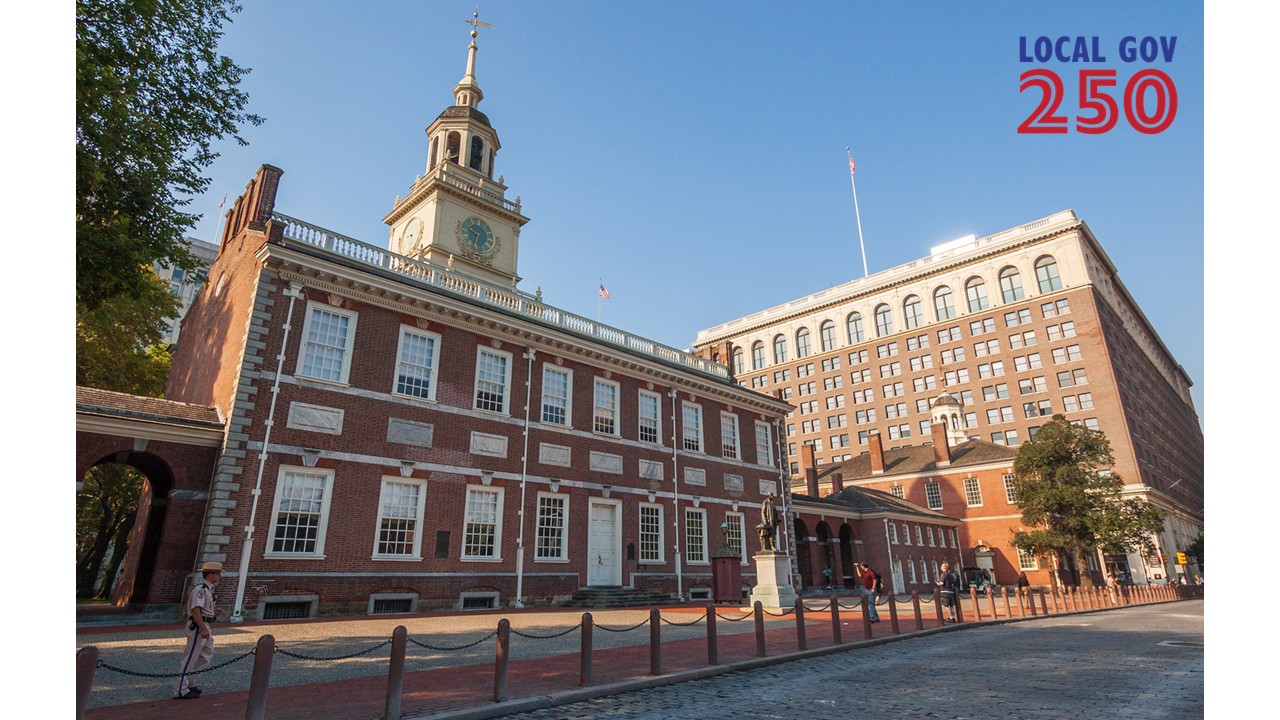
As the United States approaches its 250th anniversary, reflection often returns to its founding ideals. For generations, local governments have carried founding ideals into everyday life. Through professional administration and ethical practice, they have sustained the American experiment. This work is formative, shaping how communities learn responsibility, limits, and the meaning of self-government. It shapes how communities understand responsibility, limits, and the meaning of self-government, and it continues to evolve as local governments take on a broader role in strengthening opportunity and civic life.
From Founding Ideas to Lived Reality
The American experiment began with a claim that was both philosophical and practical. The Declaration of Independence grounded rights in a creator and established government as their protector. The Constitution then constructed a system designed to channel power, limit ambition, and preserve liberty over time. In the Federalist Papers, the framers confronted a central challenge: how to design institutions that could endure ordinary human weakness. Rather than trusting virtue to hold, the framers relied on structure to secure it. What they did not fully articulate was how those principles would be carried out in a community. The Constitution defines authority, but it does not manage water systems, maintain infrastructure, respond to crises, or determine land use and community growth.
That has been the work and responsibility of local government all along. This was not an omission, but an assumption that the durability of the republic would depend on the capacity of communities to govern themselves well. Because local governance existed before the nation itself, the framers assumed that communities would continue to carry the practical work of governing.
Local Government as the Practice of Self-Government
Local government is where the promises of the American system are tested. Residents encounter the government through the systems that support daily life. Water, public safety, infrastructure, and community services shape whether institutions are experienced as reliable and fair. Over time, those experiences build confidence or invite doubt. Because of this, local government carries a responsibility that extends beyond operations. It gives substance to the idea of self-government. It demonstrates whether institutions can function in a way that is both consistent and responsive to the community’s needs. In this way, local government makes governance credible. To sustain that trust over time, local governments require structures that support both accountability and competence.
The Progressive Era and the Question of Structure
As the United States urbanized, the limitations of early local governance became clear. Growth exposed weaknesses in administrative capacity and raised concerns about corruption and patronage. Reformers responded with a structural question: how do you keep democratic accountability while building administrative capacity? The goal was to preserve democratic accountability while strengthening administrative effectiveness.
The council-manager form of government emerged from this effort. Elected officials retained responsibility for policy direction while professional managers assumed responsibility for implementation. This model reflected a deeper understanding of governance. Representation alone was not sufficient. Effective government requires competence, continuity, and discipline. The council-manager form created conditions that sustained those qualities over time. In doing so, it helped establish professional local government as a field grounded in expertise and committed to long-term outcomes. Even the strongest structures still depend on how authority is exercised in practice.
Formation and the Practice of Citizenship
The work of local government extends beyond service delivery and contributes to the formation of citizens. Through budgeting, planning, and public engagement, communities encounter the realities of shared decision-making. Known limits and competing priorities make tradeoffs visible, and people see that decisions affect others and that responsibility is shared.
Over time, these experiences shape how people understand self-government. They reveal that freedom involves responsibility and that participation requires more than preference. Local government provides the context in which these lessons are learned, shaping how individuals engage in a system that depends on cooperation and accountability. That shared experience now extends into a broader question about opportunity and long-term well-being.
It also shapes the baseline conditions that make opportunity realistic rather than rhetorical. Decisions about land use, infrastructure, public safety, and basic services influence whether families can access jobs, whether neighborhoods remain stable, and whether businesses can grow with confidence. When local institutions are competent and trustworthy, they reduce friction in everyday life and expand what residents can reasonably plan for. When they are inconsistent or unresponsive, the costs show up in time, money, and diminished hope. In this way, local government becomes a quiet architect of long-term well-being by sustaining the public conditions that allow people to flourish.
Opportunity, Mobility, and the New Work of Local Government
The American Dream has long rested on the belief that individuals and families can move forward through effort, responsibility, and access to opportunity. That belief assumes that opportunity can be expanded or constrained by the conditions in which people live. Local government has always helped shape those conditions. Through infrastructure, housing, public safety, and community services, it has created the foundation on which communities function.
There is growing recognition that local government’s work includes responsibility for long-term outcomes. Economic mobility, stability, and community well-being are influenced by decisions made at the local level. This reflects the same foundational challenge identified by the framers, which is how to design institutions capable of sustaining a free society over time.
Recent work on economic mobility and opportunity has brought this into sharper focus. Research continues to show that place matters, and the neighborhood in which a child grows up can shape long-term outcomes. That same body of work also underscores the civic importance of dignity and belonging. When people experience stability, safety, and genuine access to opportunity, they are more likely to see themselves as part of civic life. Local government helps form these conditions through how services are delivered, whether public spaces are accessible, and whether institutions respond in ways residents recognize as fair and attentive.
That sense of belonging supports civic engagement. Individuals who feel connected to their community are more likely to participate in decision-making and contribute to its future. Across the country, local governments are aligning their work with these outcomes. Partnerships with schools, workforce programs, and community organizations are expanding access to opportunity. Efforts to strengthen financial literacy and connect residents to education and employment pathways reflect a broader understanding of the role local government plays.
That task has become more complex as the operating environment changes. Technology has reshaped how services are delivered and how residents engage with institutions, and expectations for responsiveness have risen accordingly. Yet communities still depend on local government for stability and for the management of essential systems that cannot pause while the context shifts.
Professional local government provides continuity under these conditions. The council-manager form supports steady administration while allowing for adaptation, and it keeps long-term stewardship in view while meeting immediate needs. In a changing environment, that combination is not just helpful; it is the core of institutional resilience.
Conclusion: The Responsibility of Self-Government
The American experiment has always required more than the founding documents. It has required institutions capable of carrying those ideas into practice and people willing to take responsibility for their continuation. From the beginning, the nation’s framework rested on a belief that freedom could be sustained through structure and responsibility, grounded in something higher than individual will. Rights were understood as endowed by a Creator, and government was designed to secure them. The daily work of making that system real, however, has always depended on local institutions.
In cities and counties across the country, self-government becomes tangible. It is shaped through decisions about resources, priorities, and the common good. It is sustained through the steady work of administration and the participation of those who live within it.
Over time, that work has expanded. Local government has not only maintained essential services, but has taken on a broader responsibility for the conditions that shape opportunity, dignity, and belonging. The strength of a community is reflected in whether people are able to participate in and contribute to its future. This is the ongoing work of a more perfect union. It is carried forward through public servants and engaged residents who are willing to take responsibility for the communities they inhabit.
As the United States approaches its 250th anniversary, the question is not only what has been built, but what will be sustained. The answer will continue to be found in the steady work of local government and in a shared commitment to carry forward what has been entrusted to us. Recognizing the weight of that responsibility, and the quiet but essential work carried out every day in communities across the country, it is fitting to pause and acknowledge those who have sustained it with a toast.
A Toast to the United States and Local Government
To the United States, as it nears 250 years:
To a nation founded on the conviction that rights come from our Creator, and that liberty can endure when power is bounded and responsibility is shared.
To the framers who understood that freedom would require structure, and to the generations who have carried those principles into public life.
And to local government managers:
Professional management sustains what communities rely on most, even when expectations rise and resources tighten. It keeps essential systems reliable, makes hard choices visible, and holds the long view in the midst of immediate demands. It protects the public trust through competence, steadiness, and restraint.
May you continue to lead with integrity, protect the public trust, and steward the communities you serve well. And may your work, carried out in city and town halls and county offices across the country, help sustain the next chapter of a more perfect union.
Learn More about Local Gov 250
In collaboration with other local government associations, ICMA is commemorating America’s 250th anniversary by celebrating the “democracy at the doorstep” facilitated by cities, counties, regional councils, and tribal governments. Learn more at localgov250.org .

EVELYN RACETTE is an assistant professor and MPA coordinator at Grand Canyon University, and faculty advisor of the university’s ICMA student chapter.
Publish with ICMA!
We’re searching for interesting and insightful stories that can help others learn a memorable takeaway to serve their communities better.
