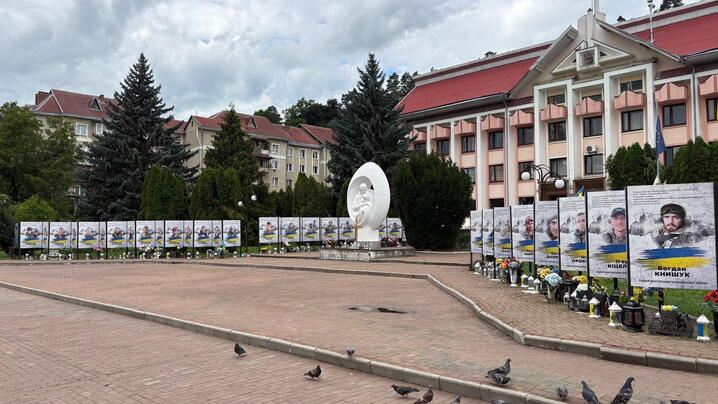
In the summer of 2025, two representatives from the city of Bruges and Bruges’ Public Centre for Social Welfare, Colin Beheydt, city manager, and Koen Gadeyne, head social worker, travelled to Kopychyntsi, Ukraine. Bruges and Kopychyntsi are partner cities and have built a strong humanitarian bond. Their visit, originally scheduled for a few years ago but postponed due to the ongoing war, became a moving testimony to resilience, solidarity, and the human stories behind international cooperation. What follows is Colin’s diary-- a heartfelt reflection on a journey that left a lasting mark.
Monday morning, August 25. I’m sitting by the lake in Ternopil, inside the recording studio of 4TV, a regional television station.
“Was your family worried when you decided to travel to Ukraine?”
Yes, they were - and still are. But tomorrow, I’ll be home again, they’ll be at ease, and life here will go on. With a smile and a tear. Many tears.
What Came Before
When I joined the ICMA Executive Board in 2022, fate introduced me to Bogdan Kelichavyi, the mayor of Kopychyntsi, in western Ukraine. From the very first conversation at the ICMA Annual Conference in Columbus, Ohio, there was an instant spark—a shared vision and energy that made collaboration feel natural. Before long, we were working side by side, turning ideas into action. In 2023, we established a partnership between our two cities.
Our journey to our partner city, Kopychyntsi, was planned for two years ago, but when a Russian missile landed near the Polish border—flying right over Kopychyntsi—my family decided to cancel the trip.
Later, when an exchange program was set up as part of our partnership, a new opportunity arose. I signed up immediately with Koen Gadeyne, head social worker and Ukraine coordinator within our public welfare department. The Ukrainian delegation would first spend two weeks in Bruges; afterward, we would travel to Ukraine with them for a week.
Koen and I could each write a book about that overwhelming week. I kept a diary—about 40 pages in total. For this article, I’ll have to limit myself to a few highlights. They are vivid moments from a journey where every minute left its mark, etched permanently in our memory. You don’t often experience adventures this powerful.
On the Way to Kopychyntsi
The drive, just over 2,000 kilometers from Bruges, went remarkably smoothly, but the stop at the Ukrainian border was abrupt and long. It took us over three hours to get through both the Polish and Ukrainian border controls. Fortunately, everything in our minivan stayed intact— including the laptops and information technology supplies our colleagues had sent along after hearing the story of their Ukrainian counterparts in Kopychyntsi with astonishment.
We didn’t get much of a first glimpse of Ukraine during the final four-hour stretch to Kopychyntsi as it was pitch black. I’d never traveled so long in such darkness before. When our headlights revealed concrete blocks and heavily armed men, Bogdan, the mayor of our partner city and our occasional driver, explained that there was a curfew. After midnight, no one was allowed outside—let alone driving around. We would encounter more checkpoints, he said, but with some luck, we’d make it to Kopychyntsi.
Shortly after 2 a.m., Koen and I were dropped off at our hotel. After this exhausting journey, all we wanted was a bed. We’d barely been lying down for 15 minutes when the air raid alarm went off in the village, followed by an emergency announcement in Ukrainian. Instinctively, I grabbed my phone—a message from Bogdan, sent 10 minutes earlier, assured us not to worry. Through the Air Alert app, they already knew what was coming: rockets were flying overhead, likely aimed at Lviv, a city of one million near the Polish border.
Just hours after passing through the checkpoints, we were painfully reminded that we were in a war zone. The calm, matter-of-fact way our guides handled it was both reassuring and astonishing.
Day 1: Ternopil, Kopychyntsi, and the Community Center
We woke to the sound of the Ukrainian national anthem, broadcast daily at 9 a.m. throughout the country, followed by a call for “a moment of silence.” During that minute, everyone stops—literally. Later that morning, on our way to Ternopil, we even saw it happen in the middle of rush hour. Traffic stopped. People stepped out of their cars, hands clasped, staring silently ahead. A haunting image.
Koen and I hesitated at first but decided to install the Air Alert app as well. It wouldn’t make a sound for the rest of the week—as if guardian angels were at work.
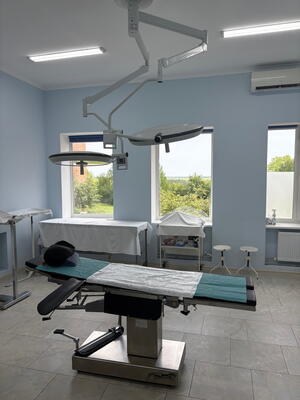
That day’s program included a visit to the hospital in Kopychyntsi. When we sent two truckloads of humanitarian aid there in 2023, most of it consisted of medical equipment—generously provided by AZ Sint-Jan Hospital in Bruges. The hospital director proudly showed us how everything was being used. The overall state of the hospital spoke volumes—more than words ever could—about the unstoppable positivity and determination of the staff.
The head surgeon, a bear of a man, performs 60 surgeries a month. He sleeps in the hospital and was eager to take a picture with me—a gesture of gratitude for the equipment that, as he put it, “saves lives.”
In the afternoon, we visited the Navkolo Community Center, made possible in part through our support. It’s a place where local residents can work, learn, and meet others. A group of teenagers was attending an English summer camp and preparing for a presentation in English for us. They were endearingly nervous but incredibly proud. Rightly so.
The community center also houses the Humanitarian Hub, a network of four volunteers who help accommodate 1,000 refugees in Kopychyntsi—a town of 12,000 people. Many Ukrainians don’t flee the country but move westward instead. One of the volunteers was such a refugee. He showed us pictures of his completely destroyed home. We were speechless.
That evening, we were expected at the city council meeting. It began and ended with the Ukrainian national anthem. I can’t imagine that happening at home. The experience would echo in my mind throughout the trip. During the meeting, I was invited to speak—something that would happen often during our stay. My translator, Oleksander, who had also visited Bruges, became my constant companion—just as I became one with Koen, Bogdan, and Mariya, Bogdan’s wife.
Day 2: Kopychyntsi and Masar Meat
On day 2 we visited a relocated factory, a company that produces custom office and school furniture. The factory had moved from Kharkiv to Kopychyntsi. The employees risked their lives in a race against time, dismantling machinery and getting it out just before the advancing Russian forces captured the city.
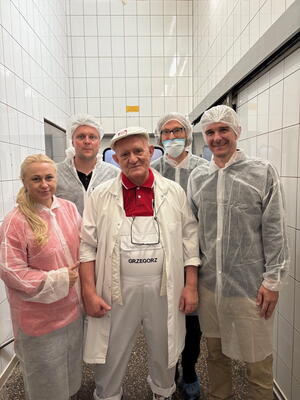
Later, Bogdan took us to a place in Kopychyntsi he’s long wanted to show us: the Masar Meat Factory, a sausage plant. A sturdy guide led us through the facility, explaining each step of the production process. It’s impressive, spotlessly clean. “Zero waste,” he proudly declares, and we believe him.
The owner, Vasyl Lypka, welcomed us into his office afterward, beaming with pride. We were treated to every kind of sausage he makes and…whiskey. Not a common pairing, but on a Friday night, we gladly make an exception.
Day 3: Kolomya, Kosiv, and the Funeral Procession
Saturday, day 3, Bogdan and Mariya took us to the market in Kosiv. They wanted to buy us vyshyvankas—traditional Ukrainian embroidered shirts—to wear the next day for Independence Day. The drive to the market is long, taking us through Kolomya, the gateway to the Carpathian Mountains. The landscape is breathtaking, lush, abundant with fruit trees, and full of natural beauty.
Along the way, Bogdan talked about the war. “Putin’s goal isn’t to seize more land,” he said, “it’s to strip Ukraine of its independence.” He added, “When a mayor goes to the front line for publicity, it comes with consequences. You become a valuable target—because if they capture you, they can trade you for at least 10 Russian prisoners of war.”
At the market, we find our vyshyvankas, but in the town center we encounter what every Ukrainian city and village reveals—and what hits you hard—rows of photographs of fallen soldiers. There are so many. My gaze drifts across the mostly young faces, and I struggle to grasp it. Why? What is this madness for? On the corner of the square stands a grim trophy—a destroyed Russian tank—as if to balance the grief.
On the way back, we stopped at a gas station. At that very moment, a hearse passes by, carrying a fallen soldier back to his village. Everyone gets out of their cars and kneels. I’d seen this ritual before on Kopychyntsi’s community page and didn’t hesitate for a second—Koen and I stepped out and knelt too. It’s heavy. Incredibly heavy.
As we continued driving, we realized our route follows the funeral procession. The road ahead, for kilometers, is covered with flowers. Along the roadside, people knelt and prayed. We watched in silence, our throats tight, unable to speak for the rest of the trip. We still haven’t been able to process it, even now. Each time the memory surfaces, the images hit harder, piling up in our minds.
Day 4: Independence Day
Sunday, August 24, is Ukraine’s most beautiful day—Independence Day. It’s the height of summer, yet the rain pours down in sheets. Dressed in our traditional shirts, Koen and I are taken to the cemetery, where families of fallen soldiers and several priests await. We take our seats, facing about 10 fresh graves. Each one is adorned with flowers, a photograph of the soldier, and both the blue-and-yellow Ukrainian flag and the black-and-red resistance flag.
The priests prayed aloud. Everyone bowed their heads as wind and rain beat down. Umbrellas open, and we huddled closer together. When the prayers ended, Bogdan asked me to place flowers on one of the graves.
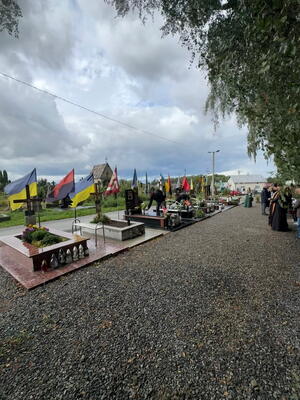
I knelt and looked at the photo of the soldier. He gazed back at me in uniform—noticeably younger than I am. The weight of his loss became real a few seconds later when I see his wife: a young woman with long black hair, wearing a light summer dress. She stood motionless by the grave, long after everyone else had left. The rain kept falling, the wind kept blowing, and it was deafeningly quiet as I caught one last glimpse of her in the rear-view mirror.
It wasn’t until the official opening of the Navkolo Community Center later that afternoon that I could shake off the heaviness of the cemetery. We joined the festivities in the village, where I gave a speech alongside Bogdan. Koen and I are welcomed once again as special guests and treated to local delicacies. The Ukrainian cuisine deserves special mention—pure, flavorful, and hearty with plenty of vegetables, potatoes, fish, and pork. Robust food, fitting for winters that are especially harsh now that critical infrastructure has been under attack for four consecutive years. Everyone keeps a backup power unit at home to ensure minimal heating.
Mariya gently pulls me away from the celebration to meet a woman who works at the library. Her husband has been missing for some time, yet she and her son still held out hope. She made a traditional Ukrainian doll for me, a small talisman, which she insists I take home as a symbol of gratitude and good luck. I promised to place it in our kitchen, to protect my family and to keep us together, always.
Meanwhile, Koen played a PlayStation tournament with local kids, even making it to the finals. I admire the way he wins hearts everywhere he goes—open, warm, and endlessly generous. I’m grateful to have shared this experience with him.
At the end of the evening, the entire Navkolo Community Center team gathered around a big table filled with pizza, meat, wine, and cognac. The drinks were brought in from Odesa and Kherson. There was laughter, conversation, and toasts—including one to the former mayor of Kherson, recently released after a long captivity. We saw photos of him before and after his ordeal. The images are shocking - dehumanizing. This war has a thousand faces.
That night, we leave Kopychyntsi—at least for now—surrounded by the warmth and kindness that we’ll forever associate with Ukraine and with the people gathered around Bogdan. Like his own team, we’ve become deeply attached to his passion and drive to make his community and his country a better place. He reaches out to everyone, in Ukraine and far beyond. Without him, we would never have made it here.
Day 5: Lviv—Unbroken
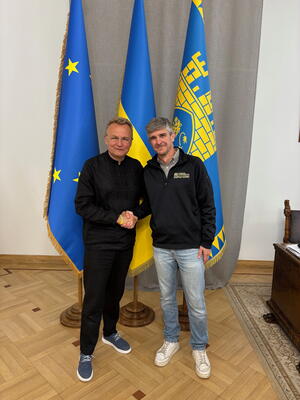
We ended our journey in Lviv, a city of one million people. We were received with great warmth by Mayor Andriy Sadovyy, who spoke about the rockets that recently struck his city. He insisted that restoring the damage quickly has become a matter of honor—if only to show Russia that, no matter what is fired at them, they will always get back up.
Lviv already has a partnership with the city of Mechelen in Belgium, but the mayor also opens the door wide to collaboration with Bruges. “You can teach us about city management,” he said, “and we can teach you about resilience and innovation.”
Innovation takes shape as we toured several sites that are part of the Unbroken project. We began at a training center with a shooting range, where children learn to shoot and to fly drones. The facility is open to anyone who registers in advance. Before we know it, Koen and I are wearing safety glasses and headsets. A semiautomatic rifle—an AK-47—lies on the table in front of us. It takes effort just to pick it up, let alone pull the trigger. The recoil isn’t as bad as expected, but the blast shakes you to the core and sends chills through your body. I just fired a real gun.
At this site we also met engineers from Levitate, a company that designs prosthetic limbs for people who have lost a leg or part of one. A British man who wears one himself told us his story. He followed the love of his life to Ukraine. During combat at the front, he lost his left foot. Thanks to Levitate’s prosthesis, he can now wear shoes again, walk, and even run. He’s determined to return to the front and fight once more. Koen and I exchanged a silent look.
The next stop in the Unbroken story is the National Rehabilitation Center Unbroken. Even from the outside, it’s clear this visit will stay with us. Everywhere we look we see young people missing limbs. You notice them all over Lviv. This war bleeds into every corner, every street, every square.
The hospital specializes in the treatment of war injuries, including amputations. As we walk through its corridors, we’re struck by the sophistication of the equipment—state-of-the-art, far ahead of its time. This war, for all its horror, has also spurred rapid progress in humane and medical innovation.
The hospital also cares for people who were captured and tortured. They receive therapy in a dedicated department. Our guide showed us a series of drawings by one soldier who endured the worst forms of torture imaginable. His sketches illustrated how he slowly learned to communicate again, to process the trauma. At that point, we were lost for words.
Later, on the hospital roof, we enjoyed a sweeping view of Lviv. The sun is shining; in a shady corner, two soldiers—both patients—are playing music. One told us his stage name is Tom Strobe and that he makes lounge music. We listened to a few tracks, closed our eyes, and for a moment we felt as if we were on a carefree vacation. The sun warmed our faces. I hope that every soldier who comes up here for a break can feel that same peace, even for a fleeting minute.
We closed our week in Ukraine in the center of Lviv, a stunningly beautiful city. I made a promise to myself: one day I’ll come back here with my partner when the war is finally over. And I hope many others will follow, making this the city trip of the future. But not just yet. We shared one last drink; by midnight, everyone must be home or at the hotel. The curfew, remember?
Day 6: Farewell to Ukraine
Lviv is still asleep when we began the drive toward the Polish border, about a three-hour trip. Just before the crossing, we find ourselves behind a truck with an open tarp in the back, packed with young men carrying rifles. Our temporary driver, Oleksander, told us there’s a nearby training center and that these men are headed to the front line.
Two border checkpoints later, we’re back on European Union soil. We caught our flight home from Krakow and are back in Brussels before we know it. The drive to Bruges passed mostly in silence.
That night, lying in my own bed, the quiet is abruptly broken—the Air Alert app goes off again. Another air-raid warning in Kopychyntsi. I immediately messaged Bogdan, Mariya, and Oleksander on WhatsApp. They reassured me: they’re awake, but safe.
“The rockets are flying by again,” Bogdan wrote. “Do not worry. Go back to sleep.”
The same scenario repeats itself in the weeks and months that follow. Through this journey, the war has come closer—tangible, personal, under our skin. It makes our work for the Ukrainian community in Bruges, and our partnership with Kopychyntsi, more meaningful than ever.
Slava Ukraini—Glory to Ukraine.
Publish with ICMA!
We’re searching for interesting and insightful stories that can help others learn a memorable takeaway to serve their communities better.
